Wyers End

Posted February 16th, 2009 by Christina and filed in Construction Articles, Stick Built, Tiny House Concept
Tags: , , , , ,
3 Comments

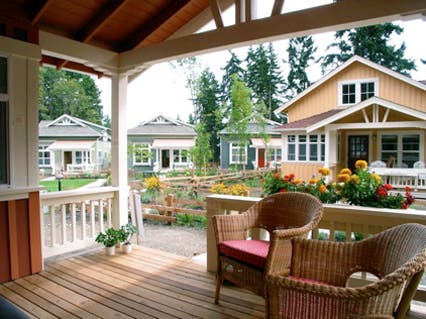
If you love Ross Chapin’s cottage designs as much as I do, you’ll be happy to know that another pocket community is now open in the White Salmon/Hood River area of  northern Oregon. The community is being developed by Smart Development and built by Skyward Construction. The landscape architect is Andrea Flint.

lisettecommons2

lisette

Wyers End is a small community of 18 cottages situated in a grove of mature oak trees with views of Mt. Hood and the Columbia River. The land parcel that the community is situated on used to be a high crime area until Chapin and Smart Development took over. They proposed to the city that the existing streets be narrowed to reduce the impervious surface area and avoid overheating of the microclimate.

Each of the cottages will have a private garden and will share the green spaces and the community building. They will also be situated to take advantage of the amount of natural light that comes in through the numerous windows. The cottages average about 1,100 square feet and include custom built-ins and cabinetry and low-VOC paints. The landscaping will be built for low water use. Parking will be on the community periphery.

“There is a market in tight times for well-designed, thoughtfully-built, smaller homes in a community setting,” Chapin said in Builder Magazine. “Baby Boomers, especially, are looking ahead and reconsidering their options. Most don’t want to end up isolated in a sheetrock castle.”

lisetteeve

we31

Photos courtesy of Ross Chapin Architects and Smart Development

By Christina Nellemann

If you enjoyed this post, subscribe to our feed

Ross Chapin and Tiny House Communities

A few years ago I was given the chance to visit the Third Street Cottages on Whidbey Island and the opening of the Greenwood Avenue Cottages in Seattle. These communities, by renowned architect Ross Chapin and developer Jim Soules, have become famous for being small, sustainable and community oriented. Chapin calls them pocket neighborhoods.

Photo from Ross Chapin.com

I think my first exposure to small and tiny houses was Chapin’s Third Street Cottages, which were featured in Sarah Susanka’s book, Creating the Not So Big House. They were so well designed and so space efficient and sufficient that it has not occurred to me since that I would need anything bigger. The Third Street Cottages are about 600-650 square feet and have a great room with living, cooking and dining areas, a downstairs bathroom with laundry facilities and a downstairs bedroom. Each house also has a full size loft that is accessed by a ship’s ladder. The owners personalize each cottage by naming their homes. I visited a cottage in the Third Street community named Plum Corner for the plum trees that were left behind during construction.

Photo by Christina Nellemann

Third Street Cottages. Photo by Christina Nellemann.

Photo by Christina Nellemann

Third Street Cottages. Photo by Christina Nellemann.

The typical cottage community by Chapin includes 8 cottages on a 2/3 acre plot that usually  holds one or two larger homes. The cottages surround a “green” area that holds seating, grass and trees and a place to grow community vegetables. A parking lot is off to the side of each community, hidden from view by a fence or bushes. Each cottage has its own small garden area surrounded by a low fence and each community has a shared tool shed and meeting room. Each small house is sold as a condominium and a monthly fee helps to maintain the garden and outlying areas.

To create a balance between the public and private areas, Chapin uses the concept of “layering”. The entryway into the main garden is the first layer, moving from public to more private. Anyone who does not belong in this area is noticed right away from each of the cottages. This way, neighbors can keep an eye on each other’s homes. The layering concept continues with the main garden area leading into the more private cottage gardens through the small fences and then each house is entered by first going up several stairs to the open front porches. The porches bring to mind the charming bungalows of the Arts & Crafts movement of the early 1900’s. The porches extend the living area of the small homes as well as offering a convenient area for neighborly chats.

Greenwood Avenue Cottages. Photo from Ross Chapin.com

Greenwood Avenue Cottages. Photo from Ross Chapin.com

I was able to view the Greenwood Avenue cottages during an open house tour and I was impressed by how the little details in the homes gave them each a different personality. Each tiny home uses architectural tricks to create a larger space: built-in bookshelves, alcoves, delineated ceiling heights between living and eating areas, ample windows and skylights. Each home is personalized with special details such as trim, woodwork (the walls of the Third Street Cottages are paneled in reclaimed spruce saved from destruction by a piano company) and cubby areas holding shelves, window seats or dining nooks.

Greenwood Avenue Cottages. Photo by Christina Nellemann.

Greenwood Avenue Cottages. Photo by Christina Nellemann.

Greenwood Avenue Cottages. Photo by Christina Nellemann.

Greenwood Avenue Cottages. Photo by Christina Nellemann.

Greenwood Avenue Cottages. Photo by Christina Nellemann.

Greenwood Avenue Cottages. Photo by Christina Nellemann.

Chapin believes in not only designing and building to save space and money, but to promote sustainability. The low garden fences are recycled fencing, the cottage’s siding is cement fiber board rather than wood, and the garden pathways were laid with crushed hazelnut shells from a local nut company.

Ross Chapin Architects also sell cottage home and small home plans. The three smallest are the Blue Sky Cabin at 307 square ft. the Backyard Cottage at 449 square ft. and the Lizzie Cottage at 540 square ft.

Blue Sky Cottage. Photo from Ross Chapin.com.

Blue Sky Cabin. Photo from Ross Chapin.com.

Backyard Cabin. Photo from Ross Chapin.com.

Backyard Cottage. Photo from Ross Chapin.com.

Backyard Cottage Interior. Photo from Ross Chapin.com.

Backyard Cottage Interior. Photo from Ross Chapin.com.

The Cottage Company

Living small — Some Utahns discovering the charm of cottages

Cottage Housing in Your Community (PDF)
A guide to drafting a cottage housing ordinance

Tiny House Village Concept post on Tiny House Design

By Christina Nellemann

If you enjoyed this post, subscribe to our feed