
Little House in Spokane
Here is our little house story in Spokane, Washington.
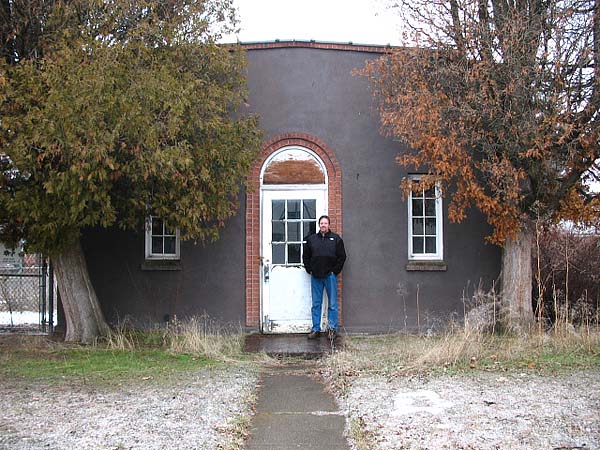
In the spring of 2006 I was walking through my neighborhood, as I had done so many times over the years and for some reason I really noticed this small, tired and neglected building with its Mission Revival architecture, very unusual for Spokane. As an Albuquerque, New Mexico transplant, I was automatically drawn to its style. It turned out the owner was a local contractor preparing to demo the building and construct a duplex. My partner, Val, and I made an offer and were soon the new owners of the North Hill Substation, built in 1930 as the local utility power distribution site with a mere 374 square feet and 13ft ceilings. We started ever so slowly, huddled in a corner with an electric heater, pen and paper and tried to wrap our heads around our vision for this great piece of history. It has evolved to what it is today affectionately called “The Little House.”

One big obstacle to this adventure was learning to let go of all my stuff. As a dealer and collector of antiques I had a daunting task ahead of me! For 4 years with the help of eBay, Craig’s List, thrift store donations and the dump I was able to whittle things down. Two years ago I was ready to vacate my 1500Sqft apt and see if I could really be happy in one fifth of the space. I made due with a woodstove for heat. I also had a propane cook top and refrigerator I used previously for camping. I found not only was it do-able, but soon realized that less is truly more. After 13 years, Val and I decided to move in together into her house. But with 2600 sqft, 3 bathrooms and kids grown and moved away plans have changed once again. Together we are diligently working towards the “small move” back to the Little House. Continue Reading »
Little House in History
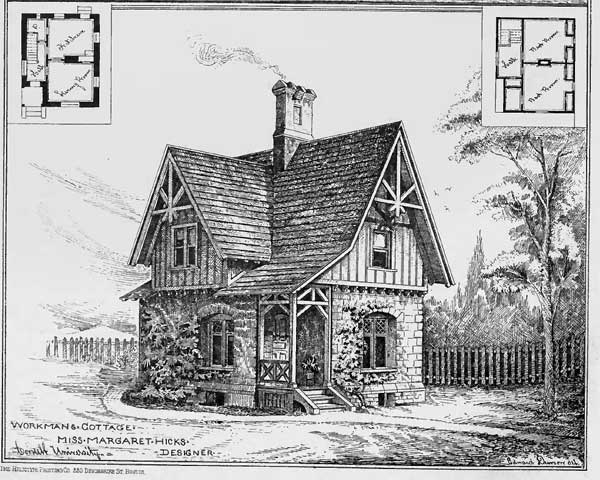
A.M. one of the Tiny House Blog’s regular readers has discovered some really neat historical homes in some old publications and has started sending them to me. I wanted to share with you one that really caught my eye. Here is what A.M. has to say:
This little house is from an 1878 architectural publication, called “American Architect and Building News” that is supposedly out of copyright. (I would imagine anything from 1878 probably is!) It featured illustrations of designs that were actually built in America, including public buildings (city buildings, hospitals, churches), as well as projects that were privately commissioned. That makes this not only cute, but perhaps (assuming this one really was built as well) even a snapshot of history!
This one is from the April 13, 1878 issue of the publication.

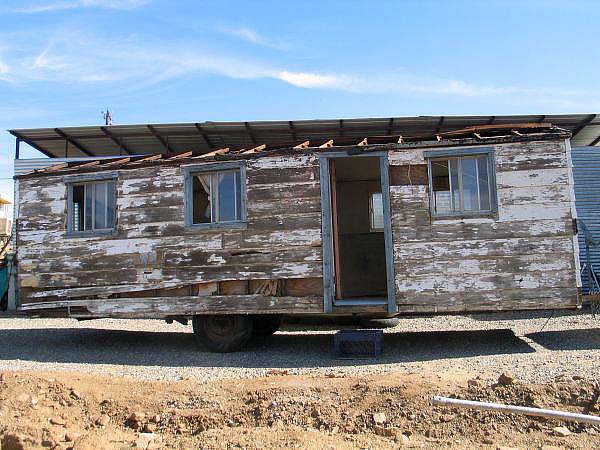
1950′s Grapes of Wrath Tiny House Trailer
At only $600, and it’s obviously in terrible condition, but it’s an interesting bit of history, and looks very similar to what many are building today!
This Grapes of Wrath tiny house trailer was discovered by Cheryl Spelts on the Inlad Empire craigslist.
Here is the actual listing:
THIS IS IT, USED YOYUR LAND SCAPE MINE OR RESTORE IT. BE THE TALK OF
RV PARK. GOT TO HAVE DOLL HOUSE, THAT PEACE MISSING ON
THAT LAND SCAPE PROJECT, ITS ROLLS IT ON WHEEL. IT NOT HOME MAY ,THEY
WERE SOLD IN THE YEAR FIFTYS..
626-833-8926 OBO
As of today this is still up so if you want a piece of history and a big project you can’t beat the price. http://inlandempire.craigslist.org/rvs/3207478247.html

The Tiny Cottages of Faubourg Marigny
The French Quarter of New Orleans usually gets most of the attention for its architecture, stylish balconies and lively street life, but a small neighborhood just east of the Quarter has a selection of some of the best Creole and Classic Revival cottages in New Orleans. In addition, many of them are tiny.
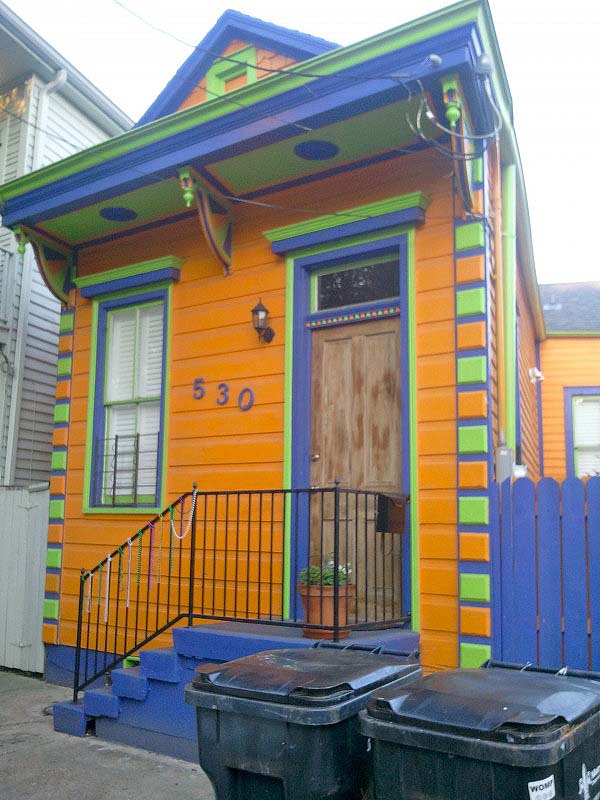
My husband and I recently went to New Orleans to visit with family and we rented a small apartment in the Fauborg Marigny area of the city. It’s only a few blocks from the French Quarter, but it feels like a different city altogether. The vibe is more historical and bohemian and less touristy and Bourbon Street-y. The main road is Frenchman, which is called the “local’s Bourbon Street”, and is known for its great restaurants, coffee shops and jazz clubs. Because the neighborhood is on higher ground, it escaped the worst of the Katrina flooding. Continue Reading »
Tiny Houses of the Historic Northwest
Zol Fox emailed me an interesting article showing some of the logging history of the Northwest and included in the email a couple of pictures of tiny houses built from hollowed out logs.
The size of the trees that were taken down in the Northwest 150 years ago is something impressive. We are not likely to see anything like this in this area ever again. Below I’ve shared a few of those photographs.

A hollowed out log became a mobile office.

Hollowed out logs were used to house and feed the crews.
I hope you’ve enjoyed this shared piece of our history.
CJ just sent me some photos he took at St. Augustine, Florida, he says: These were taken with ipod, so quality is not the greatest but they fit nicely with your post today.
Bridge Tender Houses
I recently got back from a trip to Europe to visit family and kept my eye out for tiny houses across the pond. What caught my attention in downtown Copenhagen, Denmark was a steel and copper bridge tender house. My husband and I actually peaked into the windows and contemplated if we could buy one of these things and spend our days watching the traffic and bicyclers speed past. These particular bridge tending homes are now being used as municipal offices, but I think most of these types of buildings would make great tiny houses along the lines of a lighthouse…utilitarian and beautiful.
In the past, bridge tenders were needed to run the electronics and machinery that raised and lowered bridges on major rivers, waterways and railroad bridges. The machinery was kept in a small house near or on the bridge and the bridge tender would spend most of their time in the house, or even lived there. Their jobs consisted of controlling and monitoring traffic around the bridges, keeping the bridge and the raising/lowering mechanism in good condition and running telegraph machines and other communications. Most bridge tender houses were usually built by government departments of transportation. Continue Reading »


