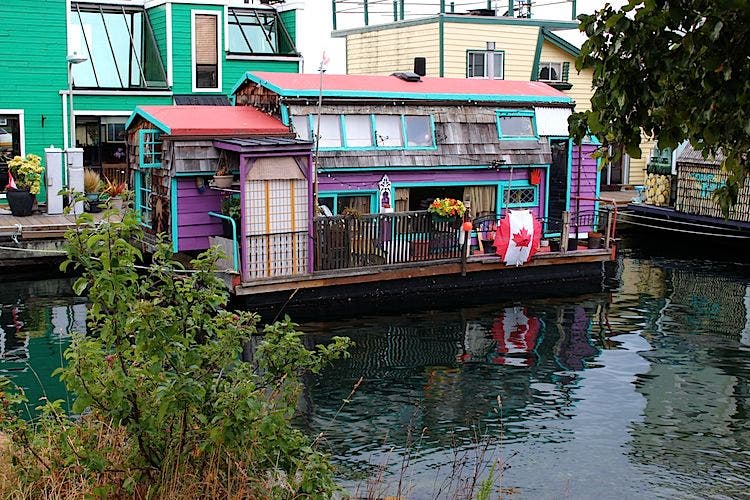
Cape Codder the Ultimate Tiny Floating Home

by Kent Griswold on December 23rd, 2008. 13 Comments

If you are looking for the perfect tiny floating home, take a look at berkeley-engineering’s Cape Codder. Built with a 10 foot beam and either 20 or 24 foot length this cool little home is neat to look at and very practical and easy to build.

The Cape Codder is the result of many requests for a liveaboard/cruising houseboat. The Cape Codder makes it possible to have you own private waterfront home.

Cape Codder

The Cape Codder is a home. It has a couch and end tables, a diningroom set, a complete galley and a head with a shower and toilet! There is plenty of cupboard and drawer space. The inside ladder leads up to the sleeping loft, which has room for full sized mattresses and more storage space. The forward wall opens up to enjoy your own private sundeck. A roof skylight lets you sleep under the stars.

Plans are available for the Cape Codder for $225 and you can buy them at the berkely-engineering site. Click on the Order Here link. Berkely-Engineering also makes a smaller trailerable houseboat called the Aqua Casa. I will feature this tiny floating home in another post.

Cape Codder Rear View

Cape Codder Rear View

Cape Codder Open From Dock

Cape Codder Open From Dock

Back Door

Back Door

Living Room

Living Room

Dining Room and Kitchen

Dining Room and Kitchen

Upstairs Bedroom

Upstairs Bedroom

capecodder24specsheet

If you enjoyed this post, subscribe to our feed

Living on the Water

by Kent Griswold on November 8th, 2008. 15 Comments

By Margy Lutz, Powell River, BC

Christina Nellemann recently wrote an article here on the Tiny House Blog about living on a boat. In it she pointed out some of the challenges and pleasures of life on the water.  My husband Wayne and I live on the water, but in a whole different way.  You may have read a little bit about it in the October 21 article “Our Little Cabin Up the Lake.”  Kent has invited me back to tell you a little more about living in a floating cabin.

Cabin in Winter

What first attracted us to our cabin on Powell Lake in British Columbia was its simplicity.  We live there in all seasons. While we’ve made a few changes over the last seven years, we’ve kept the simple life foremost in our minds. Our cabin has 420 square feet downstairs and a 200 square foot sleeping loft under the peak of the roof.   Our kitchen is compact but functional. It’s plenty of room for one, but two makes a crowd. On one wall you will find my sink and shelves to store my pots and pans. The window has a great view of the entrance into the Hole in the Wall. With a view like that, you almost don’t mind doing dishes.

Kitchen

Kitchen

When John built our cabin he installed a hand pump. It draws water from about six feet below the lake surface. To be safe, we boil it before drinking. Continue around the L-shaped counter and there is my small stove and oven. Open wall shelves hold our dishes and food. Under the counter are two plastic drawer units. To deter mice, we keep foodstuffs in containers, especially when we aren’t there. But we’ve been very lucky so far.

Pump

Pump

Tucked under the stairs to loft is a small refrigerator. It even has a freezer that really comes in handy during the summer for ice to make ice cream. Both the stove and refrigerator run on propane. Along with propane lights, a 60 lb. tank lasts about six weeks for $54. We have to haul the tanks to town in our boat, but once every six weeks isn’t too bad.

Refrigerator

Refrigerator

I have to be honest. At the cabin, Wayne is first cook, especially when it comes to the barbecue. But I do have my specialties including cakes, breads and soups. This goes to show you don’t need a big fancy kitchen with lots of electrical appliances to make good food.

Cooking Stove

Cooking Stove

Especially this time of year, our wood-burning stove is the heart of our cabin. With occasional stovepipe cleanings, it keeps the fire roaring hot, or low and slow, depending on our need.  I’ve even found a few creative ways to use it to back cakes and bread.

A wood stove must have wood. For us, that’s a fairly simple. Especially during high water, the wood floats right to our front porch. All we have to do is scoop it up, cut it up (sometimes) and let it dry. When we are gathering wood throughout the summer, we are dreaming of the cozy fires it will bring during long winter nights.

Wood Stove

Wood Stove

Storing wood on our cabin’s float is problematic. We want it close by, but not weighing down the foundation for our cabin. Our floating woodshed and a small covered woodpile on our transition float to shore serve this purpose well. For those really rainy and windy nights, we have our small indoor wood shelf that holds about 5 days worth of really dry wood. It takes up a little space in our “guest room,” but no one seems to complain.

Wood Float

Wood Float

Wood storage shelf

Wood storage shelf

We’ve added electrical power with solar panels and a wind generator, but use it sparingly.  We have a few low powered lights in strategic locations and use it to run and recharge a variety of devices, including a satellite radio and laptop computers.  We have cellular telephone reception with the help of a car antenna, but purposely have no television or Internet access.  The easiest way to make a simple life complicated is with too much TV or web surfing.  We get enough of that when we make weekly trips to town.  Our cabin life on the water may be simple, but is perfect for us.

You can find more information about float cabin and off the grid living at http://PowellRiverBooks.blogspot.com. For information about Wayne’s Coastal BC Stories, come to www.PowellRiverBooks.com.   Up the Lake and Farther Up the Lake have lots of information about our cabin life on Powell Lake.

If you enjoyed this post, subscribe to our feed


Our Little Cabin Up the Lake

by Kent Griswold on October 21st, 2008. 36 Comments

by Margy Lutz, Powell River, BC

My husband Wayne and I were vacationing in Coastal British Columbia when we discovered something unique and intriguing on Powell Lake, float cabins.  It was love at first sight.  We had been looking for a place to retire and knew this was it. We laughingly say, when we bought our cabin, it came with John.  This was very important. In the beginning we could only visit on holidays.  John (the previous owner and cabin builder) agreed to check on our place and help out with odd jobs.

Lutz's Floating Cabin

Lutz's Floating Cabin

Float cabins are a big part of Coastal BC history.  During the heyday of logging and fishing, they were used as support camps that could be moved from place to place.  On Powell Lake, float cabins were inexpensive hunting and fishing getaways for paper mill workers.  Today things are a little more regulated.  Cabins have registered water leases and we pay property taxes.

Cabin construction begins with the float.  John lashed huge cedar logs together with ¾ inch steel cable.  A winch and hydraulic jack tighten the cables and large railroad spikes hold them in place. Next the deck is added and finally the cabin is built on top.  John is typical of many people who live in Coastal BC.  He is self-reliant and a “Jack of all trades.”  And he has been very patient about teaching us “city-folk” along the way.

Float Construction

Float Construction

Cabin Foundation

Cabin Foundation

Our cabin is small (20×21 feet) but complete.  The downstairs has two bedrooms, one of which we use for storage and a bathtub.  The main downstairs area is a great room design including kitchen, dining and living areas.  The large upstairs loft is our bedroom.  It’s plenty of space, especially since we have the whole outdoors at our doorstep.  The main float is 40X40 and we have additional floats for a variety of purposes: a dock, a floating woodshed and my floating vegetable garden.  The garden is on a pulley.  I bring it in to tend my plants and then send it out to our log boom breakwater to protect it from hungry critters.  When Wayne wants privacy for writing, he heads out to the Gemini, a renovated boat that is his author’s retreat.

Cabin Walls

Cabin Walls

We live up the lake about 25 minutes from the marina.  Our power sources are solar and wind, with propane for cooking, refrigeration and additional lights. In winter we use a small generator to give our batteries an occasional boost.  Our wood stove keeps the cabin warm so we can live there in all seasons. An outhouse on shore may soon be replaced with a composting toilet.  Four flights of stairs up the cliff in stormy weather isn’t always fun.

Living Area and Stove

Living Area and Stove

Now that we have retired, we spend about 75% of the year living in our float cabin.  Our lives follow the seasons with wood gathering, gardening, swimming, fishing and enjoying our surroundings.  There’s nothing better than getting up early and having a cup of coffee on the deck watching the sun rise over Goat Island to herald in a new day.

July Garden

July Garden

In 2001 we purchased our cabin for $35,000 CAD which at the time was about $25,000 USD.  We figured we couldn’t go wrong with that.  Actually, because there is a moratorium on new cabins the values have risen quite rapidly.  John sold another cabin this year (a little larger than ours) for $100,000 and some are going for even more than that.  Even so, it is still within the range of many people.  Of course, that is because there is no land involved.  But we feel comfortable with our 20 year lease that is renewable from the BC government.  The lease payment is $500 a year and the taxes the same amount.

You can find more information about float cabin and off the grid living at http://PowellRiverBooks.blogspot.com.  For information about Wayne’s Coastal BC Stories, come to www.PowellRiverBooks.com.   Up the Lake and Farther Up the Lake have lots of information about our cabin life on Powell Lake.

Float Cabin Floorplan

Float Cabin Floorplan

Float Cabin Loft Plan

Float Cabin Loft Plan

View of Float Cabin

View of Float Cabin

View From Cabin

View From Cabin

If you enjoyed this post, subscribe to our feed

Floating Retreat

by Kent Griswold on September 4th, 2008. 20 Comments

It’s been awhile since I have covered any cool floating homes. Remember Steph’s Floating Cottage. She is busy remodeling it and getting ready to really move in.

This week I discovered this cool little Swedish retreat thanks to materialicious. This floating retreat is located somewhere in the Swedish Archipelago, where it is off the grid and a long ways from anywhere. It has an outboard motor on the back to move it around and flip up steering wheel on the roof.

floatinghome

I like the simplicity of the design. It makes you think that just about anyone could build a basic structure like this. The interior is finished off with white painted boards and cabinets which makes the space seem larger than it is. I don’t know the exact size as the website is all in Swedish. Go to Sköna hem to get the details. If you can translate the site and pass on everything to me I would really appreciate it.

If you are interested in creating your own floating home you might want to check out the book Handmade Houseboats: Independent Living Afloat.

Also check out the Paycheck Shantys located at OneUglyBoat for more ideas of building your own floating retreat.

Here is a translation of the floating retreat:

John and his wife anchor their house in the outermost skerries every summer. A houseboat is the ultimate solution if you want to live like a multimillionaire, but have more ideas than money. Maybe not child-safe, but the cats really enjoy themselves.

By: Per Wennberg Text: Gisela Fridén Photo: John Carlson

Published: 2008-07-26

The dark brown jalousie doors has been taken from an old outdoor toilet. John found two identical doors in Nacka Architectural and put them opposite each other – one in the bathroom and the storeroom. The open door leads out to the rear deck.

The kitchen interior consists of cabinets, shelf and plates from Ikea. Refrigerator & freezer supplied with electricity from solar cells, while the food – mostly Asian – is cooked on a small gas stove. A Thai rice cooker for sticky rice is well-used, placed by the TV on the shelf. China is Ikea, blue and white mugs from R.O.O.M. Green tea pot from Burma, and down on the bench a modernized oil lamp.

Old pine table with a view. Chairs are from Ikea and the kerosene lamp on the ceiling is newly manufactured, from Brass Master in Stockholm. Johan bought the sea urchin lamps on the table at Liberty’s in London. Out on the sun deck stands a folding table and a deck chair
in teak, easy to obtain anywhere. Kerosene lamp on deck is a storm lantern from the Nature Company.

The stern of the houseboat has an exit to the scullery and a mini spice garden. Just bend down and take the sea water in a bucket, warm it on the stove and wash the dishes in a tub of hot and cold. Washing place is bought at Heal’s in London. The outdoor storage space
has a window opening.

The kitchen and sleeping nook are separated by a small wall with recessed bookshelf. The bed is from Ikea, the sheets from Gant, the bedspread from Lexington and blanket from R.O.O.M. Danish cabin lights over the bed. The shelves have among other things, a Chinese rice paper painting from the 1800s. The motif is “houseboat.”

60 square meter houseboat (645 sq ft), including 20 on the sundeck. Almost all of the short side which faces the sea is glazed with sliding doors. In addition the houseboat has five smaller windows. When John and his wife “change the address” they go up the steps outside the kitchen corner, clamber up on the roof, fold up the wheelhouse and chug away.

The houseboat was built by carpenter Stefan Dillner,
tel: 08 718 48 48, Mobile: 0709-22 69 69
e-mail: specialsnickerier@telia.com

Photos: Johan Carlson

Dining Room

Dining Room

Kitchen

Kitchen

Floating Home View

Floating Home View

Bedroom

Bedroom

Rear Deck

Rear Deck

If you enjoyed this post, subscribe to our feed