EcoNests

by Christina Nellemann on November 9th, 2009. 9 Comments

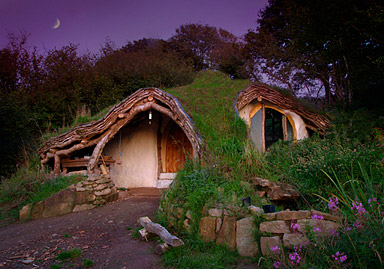
I first saw an EcoNest about 9 years ago and had forgotten about them until now. Even after studying many different types of natural building, Econests will continue to be one of my favorites because of their beautiful resemblance to the curves and colors of nature. They might even be the closest way to be outdoors without stepping out the door.

house_005

EcoNests are simple, elegant, and healthful handcrafted dwellings that welcome owner participation in their construction. Continue Reading »

Tiny Adobe Casita

by Kent Griswold on September 11th, 2009. 3 Comments

I am out of town today and was not able to get a detailed post up, so thought I would share with you a post Michael at Tiny House Design put  up a week ago.

I wanted to make sure that our readers saw this cool little adobe casita featured on his site.

Samuel Gray from Abiquiu, New Mexico built this cute little 12′ x 10′ adobe structure and currently uses it as a part time residence. He plans to move into it full time in a few years.

Sam spent $3000 building the structure and did a beautiful job. To read more about it please go to Tiny House Design and read the full story and view more pictures.

casita-600x450

New-desk1-600x450

Photo Credit: Sam Gray

by Kent Griswold (Tiny House Blog)

If you enjoyed this post, subscribe to our feed

Posted September 11th, 2009 by Kent Griswold and filed in Earth/Cob, Tiny House Concept, Your Story
Tags: , ,
3 Comments

Hap and Lin’s Cob House Journal

by Kent Griswold on September 2nd, 2009. 14 Comments

In the fall of 2007 my wife Lin and I gave up our condo and pitched a tent in an Iowa field to live immersed in nature and without debt.

The tent was soon flattened by a thunderstorm and replaced with a tow behind camper that we picked up on ebay for $700. Even with a tiny woodstove, the camper wasn’t up to an Iowa winter so we journeyed to Oregon where the summer before we had done cob building workshop with Ianto Evans and Linda Smiley.

107428715.E3d9OGud

Cob is an ancient building method that combines clay soil, sand and straw in a free form, frameless structure. The typical thatched cottage of southern England was built with cob and Ianto, a 70 year old Welshman, has led the cob revival. The book he wrote with his wife Linda and Michael G. Smith is aptly titled, The Hand-Sculpted House. Modern cob structures often take full advantage of cob’s sculptural possibilities with curving walls, dragon reliefs and frog mouth pizza ovens.

When Lin and I returned to Iowa early in the spring (actually, a little too early), we started digging a foundation for our own cob cottage. We had no intention of trying to stuff all our activities into a small house. By this time we had built an open shed out of recycled wood and roofing to house a summer kitchen, outdoor shower and workshop. We had no desire to move indoors but we didn’t want to be forced to travel all winter either. So we designed a 14 by 18′ winter room with a high pitched roof to give us a sleeping loft.

Our photo website http://www.pbase.com/hapm/ourhouse has details of our building process. In Iowa the subsoil is high in clay, great for building but not good for drainage. Our gravel foundation drains to daylight as does a curtain drain around the high side of our building site. After starting the walls with old concrete and limestone, cobbing began on June 1, 2008. For the next 10 weeks our days began with muddy feet as we mixed our house, batch by batch on tarps. Many new friends would be made doing the cob dance. This must be the most low tech way to build a permanent structure. Whole families joined in and even two year toddlers were able to contribute.

By the end of August the roof was on and we were no longer losing sleep trying to keep our cob covered from the Iowa rains. After another two months of plastering and doing the cob floor, we moved in, just in time to crank up the woodstove. We spent $7,000 on the house and none of it was for labor. Most of the money went into the windows and roof system.

In the “developed” world, houses are made to be plugged in to existing infrastructure. The modern house doesn’t function without connections to water, sewer, electric power and often natural gas. This dependency on infrastructure strikes me as a huge risk considering the current potential for environmental and economic changes and to say nothing of Murphy’s law. In our little house we filter rainwater for drinking. We heat with scrap wood. Our electricity comes from a small photovoltaic system. Our only connection to anything is a phone line. Because our lifestyle is a small step away from camping we are quite content with our minimal facilities.

Tiny houses will play a big role in creating a sustainable future for mankind on earth. Almost half of our countries carbon footprint is caused by the manufacture and maintenance of our structures. For Lin and I, the tiny house is part of our goal to live cooperatively in nature. Based on the hundreds of people who have visited and helped with our construction, this is clearly a shared vision.

We are coming to the end of our second building season on the land. Two more houses have sprung up. One is a strawbale house that we are helping to build for my folks with Brad Young the paid main builder. The other is a 14×14′ bedroom/house that we are building with our daughter Anna. http://www.pbase.com/hapm/annahouse This bale/cob hybrid will have a living roof and will cost half as much as our house. The wall building that took 10 weeks with our cob house took one week with Anna’s bale/cob. The bales in the walls will have a much higher insulation value than straight cob. Anna will use her grandmother’s kitchen and bath, another example of sharing and saving.

By Hap Mullenneaux for the (Tiny House Blog)

Cob Loft Bed

Cob Loft Bed

Cob House Kitchen

Cob House Kitchen

Wood Stove and Stairs

Wood Stove and Stairs

If you enjoyed this post, subscribe to our feed

Posted September 2nd, 2009 by Kent Griswold and filed in Earth/Cob
Tags: , ,
14 Comments

Recipe for Building a Cob House

by Kent Griswold on August 23rd, 2009. 12 Comments

Over the past nine months we have been following Brian or Ziggy as his friends call him build his cob house. You can check out the last two posts on the build here and here.

Ziggy emailed me Friday night to tell me he has completed his home and moved in and has set up a page with a recipe for building a cob house on his blog. Here it is in a nut shell:

With $3000 for supplies and nine months of full time labor, Ziggy was able to build GOBCOBATRON, a small cob house with interior dimensions of roughly 15′x13′, and a footprint of (again, roughly) 20′x18′. Practically all of the labor was completed by hand (and foot!), including making and applying all of the cob.

3742194643_d344812b84_b

Here’s what Ziggy actually bought, and what he paid for in building supplies:

  • sand (just over 30 tons total) – $507
  • gravel (about 13 tons total) – $177
  • straw (16 bales) – $36 (most straw I used was free)
  • black walnut scrap lumber – $100
  • misc. lumber – $20
  • windows – $220 (two casement, one double hung window)
  • electrical – $28
  • galvanized wire – $30
  • nails – $100 (I couldn’t believe how expensive nails are)
  • raw linseed oil (for floor) – $72
  • EPDM pond liner $622
  • polycarbonate for skylight $400

and for the rocket stove:

  • firebricks – $70
  • flue pipe – $228

It’s true… you can build your own cob house with little money, but with lots of time and enthusiasm. There’s nothing quite like the experience of building your own home with little more than your hands.

Visit Ziggy’s blog for the complete story.

Thanks Ziggy for sharing your journey with us in building your cob house.

3747768460_2b53ff8d7b_b

3767798390_cc9b32e2c1_b

by Kent Griswold (Tiny House Blog)

If you enjoyed this post, subscribe to our feed

Posted August 23rd, 2009 by Kent Griswold and filed in Earth/Cob, Tiny House Concept
Tags: , , ,
12 Comments

Building with Cob

by Kent Griswold on June 16th, 2008. 6 Comments

Those of you who have an interest in building with cob as in the Little Cob Cabin posted recently, will enjoy this site by Brian Liloia one of our readers.

Brian is a 23 year old currently living at Dancing Rabbit Ecovillage, learning to fulfill his desires to live more sustainably and self-sufficiently.

There’s a growing need to help shape a more eco-conscious, less destructive, and healthy culture, and he hopes to share some of his experiences living in a community that values these qualities.

cobfloorplan

Building With Cob

Brian explains his cob building process that they have developed over the past few weeks.

  • Mixing Cob: The first step is the “burrito”, which consists of the final cob mix of sand, clay, and straw. When the consistency is right the mixture will roll and shape into a burrito.
  • Making Cobs: The second step is to make “cobs”, or little loafs of the material. Kind of like kneading dough. Each loaf should only take a few seconds to make.
  • Cob Wall: The third step is moving the loaves to the wall and lining them up. The wall is soaked with water before applying the new loaves.
  • Cobbler Thumbs: The fourth step is taking cobbler thumbs ( a wooden tool) and “stitching” the cobs together, by working the straw into the layer below the new cobs and blending them together.
  • Cob Finishing: In the fifth step you use your hands to create a clean, plumb edge.

Brian’s cob cottage footprint is 20×16, and the structure is spiral-shaped, with an urbanite foundation and all cob walls. The house will feature a reciprocal living roof, and it will make maximum usage of passive solar and feature a rocket stove connected to a mass cob bed.

Cob Building Photographs

cob1
Urbanite Foundation

cob2
Making “Cobs”

cob3
Three Foot Cob Walls

If you enjoyed this post, subscribe to our feed

Posted June 16th, 2008 by Kent Griswold and filed in Earth/Cob
Tags:
6 Comments

Little Cob Cabin

by Kent Griswold on June 4th, 2008. 18 Comments

Hi Everyone. Sorry it has been so long since the last post. My computer’s mother board started to die and it took a few days to get it replaced. I need to get a back up computer in the near future.

Today we are going to look at a cob cabin.

Building with Cob

This beautiful cabin was built by members of cobworks.com and cob cottage. Located in Mayne Island British Columbia, Canada.

Little Cob Cabin

Little Cob Cabin

Cob is a mixture of sand clay and straw - wet enough to mold yet dry enough to build up without forms. Walls are built up to be monolithic, which gives them greater strength in earthquakes. Cob invites your creativity to be expressed in the process of building your space: living space, meditation space, work space, sleeping space, play-space. Build curved walls, arches, and niches. And who says that walls are flat? All it takes to make the step towards your dream space is a fairly short learning process, to gain a sense for the material. A fun way of learning is to participate in a workshop, where you work on a structure and learn hands-on, with opportunity to discuss your ideas with others, pick up knowledge of the whole process and meet new friends.

Cobworks

To learn more and to check out workshops visit cobworks.com.

hildesinsideovaldoor1
Entry Door

hildesinsidefireplace1
Fireplace

hildesinsidekitchen1
Kitchen

hildesinsidestaircase1
Stairway to Loft


Posted June 4th, 2008 by Kent Griswold and filed in Earth/Cob
Tags:
18 Comments