Ocean Cliffside Tiny House
by Francis E.L. Watson
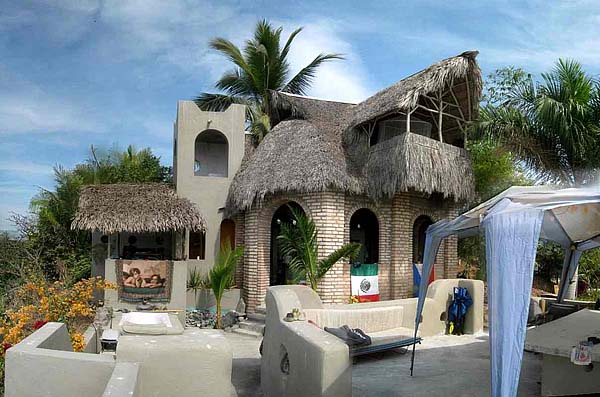
Twenty-five years ago I purchased an ocean cliffside lot in a sleepy little pacific coast Mexican fishing village. The Idea was to slooooowly build the way the village locals do – as you can afford it! A couple of years went by and I married a tropical woman. We decided to design and build a little tiny house on it. The first decade or so was spent slowly building a series of retaining rockwall terraces on the very steep hillside.

We began construction of The Bird House in 2000, and, finished the first incarnation 7 years later. It is built 70 meters above the ocean beach, straight up! In the photo the place looks huge, but in reality the main structure is only 5m x 6m and a 7.5m inside roof peak. Concrete, brick, stone and palma royal thatched roof construction. It is a ‘breathing’ house using two towers that act like morning and evening wind chimneys. No doors in the passageways, no glass or screen in the windows, only heat absorbing archways that bring in the outside without the tropical heat.
Off the electrical grid with multiple grey water fields that irraigate fruit orchards. Typhoon/storm bunker built into sw middle corner below outside living room. The place is set up for our annual journey south in our vintage motorhome, The Big Fish’. And that’s another story!

WorldHaus: Idealab Invents Super-Cheap House
As a tiny house enthusiast I think it is important to look at all options around the world. We can learn from other people and I like to share as many of these ideas as I can.
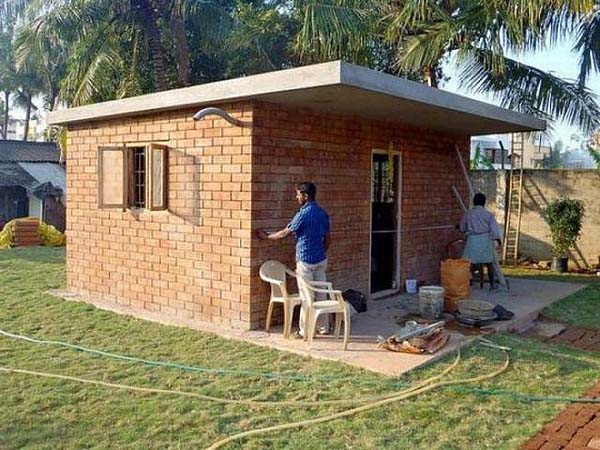
Tom Bennett recently sent me to WorldHaus a company that has come up with an affordable home for the masses (outside the U.S.). And by affordable they mean $1,500 per house. It’s called the WorldHaus; it is a 220 square foot home built of interlocking compressed earth-bricks, steel and polystyrene roof panels, and concrete.

The bulk of the materials are assembled on site and the house can be built in 10 days. They provide solid, weather-tight housing for about half the price of a normal brick-and-mortar home.

Read more: http://worldhaus.com/
http://www.businessinsider.com/worldhaus-cheap-house-2012-
http://letheatredemoncerveau.blogspot.com/2012/02/worldhaus-for-families-in-need.html
Building a Tiny Off-Grid Cabin in New Mexico
A few years ago we purchased some vacant land in northern New Mexico. We chose that area based on a number of factors. Some of those included wide-open space, abundant sunshine, affordability and artistic history (Georgia O’Keeffe lived down the road a bit). Our long term goal is to retire there and pursue a simple artistic life. One of the main reasons we chose that piece of property is its remoteness to other neighbors and the lack of congestion that comes from urban living. Urban living has a lot of advantages like electricity, water, and corner coffee shops. We plan to work around some of these conveniences using “off-grid” practices. I have enjoyed camping since I was toddler. The slower pace of life in an environment more closely linked with nature has always been a draw. Our cabin provides all of this with far more elbow room than a tent. Add in windows, a wood stove and a comfy bed and what could be better?

Site Location and Solar Power
Our parcel of land is a bit under 42 acres and nearly all the land around us is uninhabited grazing land. In fact, the people we bought our land from still graze horses and cattle on their square mile that surrounds us. I have spent enjoyable nights there listening to the baying of cattle and cry of a lonely coyote. Our decision to go “off-grid” was simple: the nearest utility pole to our cabin is nearly a mile away. We could have paid thousands of dollars to run power poles and lines to “connect” but then those “lines” would disturb our pristine views and require a monthly payment. For a fraction of that cost, we simply installed a basic PV (Photovoltaic) system. Our cabin is small at a bit under 200 sq. feet and has modest energy needs. Continue Reading »
Peter’s Concrete Block Dome
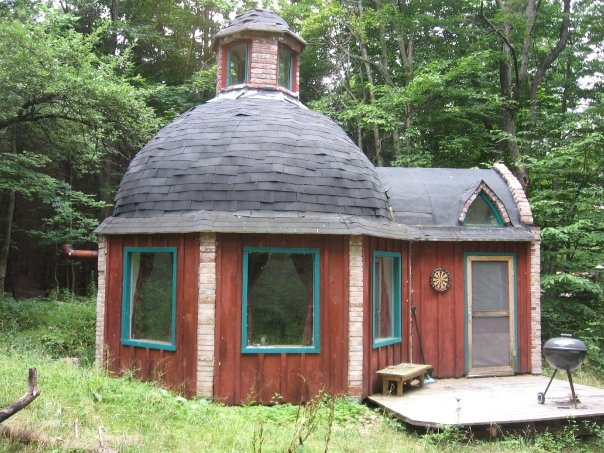
Peter Roberts has been building a unique dome structure in the woods and is sharing it with us. I discovered Peter when he posted a picture on the Tiny House Blog’s Facebook page.
Peter’s inspiration came from throwing giant pots. Peter was throwing large pots, and they became architectural, it prompted him to investigate ceramic houses, this led to the masonry system you see in these pictures.

Peter graduated from the NYS College of Ceramics at Alfred University with a degree in Masonry Science. Peter combined his experiences in Fine Art and Ceramic Engineering. This masonry system was identified as a Cutting Edge Technology by the American Concrete Institute. These blocks can be made on any production block machine, either Besser or Columbia. Continue Reading »


