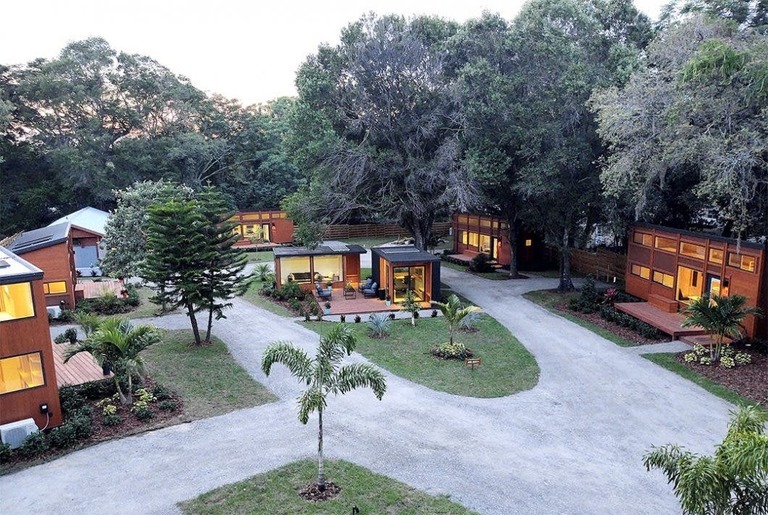
Dan Louche’s Tiny House Build Along

by Kent Griswold on January 3rd, 2012. 6 Comments

Dan Louche from Tiny Home Builders is going to be offering a unique workshop starting in March and I wanted to make sure you all new about it. I’ll let Dan tell you about it below.

Building a tiny house by yourself can be intimidating, especially if you have limited construction knowledge. But imagine if instead of doing it alone, you were part of a community of people with different levels of knowledge and experience working in tandem toward the common goal of building and living in a tiny house. In this community there would be an experienced instructor who was there to guide you and answer all of your questions along the way. This is the idea behind the Tiny House Build Along.

At the end of six months you could be living in your own tiny house. A house that is mortgage free, environmentally sustainable, that you built with your own hands. Beginning on March 1st 2012, I will be building a tiny house, and I invite you to build yours with me.

Participants will get access to an online community where each step of the build process will be broken down and scheduled to allow ample time for completion. Illustrated instructions and videos will be provided for each step so that you understand exactly what needs to be done. There will also be a discussion area where you can post your questions which will be answered by your fellow builders and myself. For each step there will be an opportunity to call in and ask your questions with the instructors answers broadcast live over the web to all participants (these sessions will also be recorded for others in the event someone is not available at the specified call time). My personal number will also be provided for a limited number of immediate answers.

The total cost is $849 and includes your choice of one of the Tiny Home Builders tiny house plans (Tiny Living or Tiny Retirement), the Tiny House Construction Guide, and unlimited access to the Tiny House Build Along online community.

You’ve dreamed of living in a tiny house, if you’ve thought of building your own home, but didn’t know where to start, then this is it! This is your start!

Reserve your spot today for $99.
Learn more at tinyhomebuilders.com/buildalong.

Built by Friends: Evan and Gabby’s Tiny House

by Christina Nellemann on October 24th, 2011. 28 Comments

Like an Amish barn raising, Evan and Gabby’s tiny Tarleton house is going up piece by piece with the help of friends and family. The Illinois couple were inspired by the Tumbleweed houses and decided to downsize their already sustainable lifestyle even more. With no prior construction experience, they have been working on their tiny home for just over a year and plan to move in (along with their two cats) soon.

The couple also plan to move around the country, staying in campgrounds that offer year-round rates. They then want to purchase some land where tiny house living is more acceptable.

Their 117 square foot Tarleton, built on a car hauler trailer, will have a great room, a sleeping loft above the bathroom and kitchen, another storage loft above the door and a bathroom with a custom shower and composting toilet that vents to the outdoors. The kitchen has four feet of stainless steel countertop, a two-burner stove, a bar sink, a toaster oven, a small fridge and – rare for a tiny house – a combination washer and dryer that they got from a family member for free. Continue Reading »

Tiny House Community Survey

by Kent Griswold on October 7th, 2011. 34 Comments

The Tiny House Community survey and blog are designed to gather the thoughts of tiny house fans on creating a community of tiny houses.

The ideal is to create a village where size is not an issue but quality of life is. Beautifully crafted tiny houses of less than 400 square feet will form the core of the community but space will be provided for larger homes and temporary shelters as well. A community center will provide services such as laundry, showers, toilets, a shared kitchen, and individual storage units.

The vision is long-term. It’s likely to require a year or more of planning, another year or two of working through permitting issues, at least six months of fund raising, and years to build up the infrastructure and build the tiny houses, before it’s a true community.

In ten years when it’s done, some of us will be old. But if we’re lucky, we’re going to get old anyway, and how much more wonderful to be old folks who created a tiny house community! If you’d like to have a say in where it’s located and what it contains, please complete the survey by clicking here.

Photo Credit Jay Shafer

Cae Mabon

by Christina Nellemann on May 16th, 2011. 13 Comments

The Cae Mabon Retreat Centre in North Wales has been building small, natural dwellings for their residents and visitors since 1989. This intentional community is located in the best of what nature can offer: in the woods, by a river, near a lake, at the foot of the mountains and within sight of the sea.

Cae Mabon’s principal creator is Eric Maddern, who was inspired to create the community after spending time with the Aboriginal people in Alice Springs, Australia. He wanted to create a place that was not the ostentatious beauty of the wealthy but the humble beauty of the simple and natural. The buildings he created are mostly made from timber, stone, reed, straw, grass, lime and clay and they blend in with their surroundings. Continue Reading »

Baggins End Domes

by Christina Nellemann on March 14th, 2011. 24 Comments

Baggins End, on the campus of the University of California, Davis is a small community of undergraduate and graduate students who live together in a bundle of round, white domes among several acres of community gardens, chicken coops, trees and flowers. Sounds idyllic, right? The students think so and are prepared to fight for their little slice of heaven. Recently, the university has determined that the domes are no longer safe for residential use and plan to shut down the Domes and Baggins End this summer.

The university’s student housing department said the Domes are not up to code, are not Americans With Disabilities Act-compliant, and not worth spending money on to salvage. Supporters of the Domes claim the university administration has neglected these issues for decades and is trying to make a land grab, motivated by budget cuts and pressure to squeeze every last dollar out of campus real estate.

Sacramento News & Review Article on Baggins End

Sacramento Public Radio Story on Baggins End

The Domes have been on the campus since 1972 and are constructed of three to four inches of polyurethane foam surrounded by a fiberglass shell. A few of the Domes are beginning to delaminate. Baggins End (named after the home of Bilbo and Frodo Baggins from The Hobbit and the Lord of the Rings trilogy) is comprised of 14 domes housing 28 students where they emphasize cooperation and sustainability. The students grow a lot of their own food and raise chickens and a rooster named Chamomile. The Domes are around 450 square feet and contain a kitchen, living room, two bedrooms or a sleeping loft, heating and skylights. The students are allowed to perform their own construction projects and have access to the community’s free materials yard, fire pit,  garden and tool shed, compost pile, greenhouse and the weekly potluck dinners. Each resident pays $2,712 for a year long lease. Continue Reading »

Podpads

by Christina Nellemann on November 29th, 2010. 19 Comments

What might look like a small toy village is actually a set of tiny houses used for camping and protection during music festivals in the United Kingdom. Podpads are designed to be a fun, comfortable and secure solution to the less attractive aspects of camping. They are rented out at various festivals for around 350 GBP or $550 a week and can be purchased as a guest house or child’s playhouse.

Designed and developed for Glastonbury Festival 2005, the podpad will stand up to the most severe of weather conditions. They are comfortable, weatherproof, cool, soundproof, secure, and safe with optional extras available to increase comfort. They are also a possible solution to a group base camp, on-site storage, as well as live-in accommodation.

The podpad is designed to accommodate two adults comfortably on either a double or twin beds. In exceptional circumstances, they can accommodate a family of three. The podpad is 8 feet by 6 feet with a wooden floor and a fitted carpet. They have raised beds with mattresses, shelving, windows with curtains, a mirror, light and a 12V socket. Podpads are also solar powered by a panel outfitted as a sunflower on the roof. This can be used for low usage items such as charging cell phones, laptops and iPods. Continue Reading »