“We aren’t building big, we are dreaming big and dreaming innovation.”
Mokihana and Pete have recently finished their beautiful VardoForTwo and are living in the woods of the Olympic Peninsula of Washington with their cat, Jots. Mokihana suffers from multiple chemical sensitivities (MCS), an illness that makes her very sensitive to laundry products, perfumes, household cleaning supplies, pesticides, wood smoke and traditional building and construction materials. She and Pete decided to control their own environment by building a small gypsy caravan, or vardo, to live and travel in.


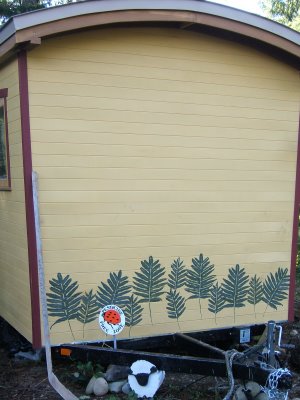
To combat Mokihana’s MCS, they painted their 12 foot long by 8 foot wide vardo with paint made from milk and have insulated it with recycled denim batting and wool batting. They use a ceramic heater and an air filter inside their tiny home. Their cooking area is outside under an awning.
The couple got a lot of their ideas from the Tumbleweed Tiny House Company and also embrace the same tiny house concept as Jay Shafer. Their blog sums up the concept of creating a house that is both healthier for the homeowner and the enviroment:
“Building VardoForTwo as an MCS safe home involves attention to detail and conscious choices every step along the way. The cost of a simplified and safe home means it takes more time and a willingness on both our sides to be respectful as we learn what works, and what doesn’t. We are building a sustainable lifestyle in a teeny home to be. In so many ways this is contrary to the old American Dream.”
Photos by Mokihana and Pete/VardoForTwo


If you enjoyed this post, subscribe to our feed
Okay, I do not know these people, and I am sure that they are nice but, just look at the “campsite” photo. It looks like Appalachia in the 1930’s. Would you want to live around folks that don’t live in there caravan, or Tiny Houses but live out and around them. There is a mis-fitting tarp over some kind of metal frame, a garbage can near food, etc. Just an ugly mess.
This is why most Marinas and great caravan potential stopping locations will not let us live there as most (yes, really most) people living the vagabond lifestyle – live outside of their Tiny Houses, not inside. Part of living this way is the freedom from having just too much useless stuff to cart around, not to drag it with you and quickly unload it at your next home site.
Until people really take responsibility for their immediate surroundings and not keep trashing their plot, the rest of us will be labeled as “Trailer Trash” “Dirty Gypsies” etc.
Sincerely, Coutch
Liveaboard since 1988
Sear grouch,
You are missing the whole point of why they are living like this.
The woman has chemical sensitivity as do I .
I was poisoned a few yrs ago by my land lord.
Very very l ong story.
But what happens with people like me is this.
They becom allergic to everything.
Car exhaust, laundry soap on Your clothing, just to be wound people, the soap fumes that come off of THEIR CLOTHING is enough to make most CHEMICALLY INJURIED PEOPLE feel sick.
No of us that have CI WANT to give up our homes, that we loved, our jobs lat we loved to be forced to go live in the woods.
It is a very lonely way to live.
In a regular neighbor hood, the chemicals coming from all of my neighbors on a Saturday when they are doing their laundry, is overwhelming.
Let alone the lawn and yard care co. That. Come and spray or fertilize, or the person 5 houses down that sprayed round up on their weeds growing in the yard.
No nope want o live this way.
Aptmanet living is impossible for the same reason.
Even trying to be a room mate to someone is very difficult.
People like to wear their perfumes, and use glade or febreeze air fresher, for m any CI carpet and the glue used to hold it down makes us sick.
It’s not the smells it’s the chemicals used in these products that make us sick.I have actually had seizures due to pesticides spray.
Your right you can’t live in a house this small, you do have to start doing things outside in a covered area. But at least they have a sAfe non toxic SMALL area in whicthc to sleep.
Hopefully feeling well ands refreshed when they wake up the next day once again trying to be chemicals free.
This is such a hard disease to understand or even describe.
I really didn’t believe in. It, until I got it.
It completely changed my life.
I owned. House in north bend Washington, and. In Rizona.
I can’t live in either of them now.
The hit inwashington because of all the lawn care co.
The house ins Arizona, because everyone sprays for bugs.
I live in ONE room, with 2 air purifiers and my oxygen machine prescribed by my doctor.
It’s very lonely, I live 50 miles from the neWrst store.
I never invite people into my clean safe place, because fter they leave, I can smell all the body lotion, hair products, laundry soap oozing off of them.
I can smell it the minute they get out of their cars.
Oh yes, let’s not forget the car air fresher trees, with that cloying sticky smell, that gets misses he’d I n everything it comes into contact with.
Most clothingitry Toby, come from india, it’s made in other countries.
They not only spray the clothes before they Re shipped with pesticides, they also spray the shipping containers that they come in on the boAtes Nd trains.
No you will never ever be Bleto understAns living like this, unless you have to, due to illness from chemicals.
This is a horrible way tollive
. But for some of os it’s the only way we don’t feel like walking death, all day long.
So so so sad to live like this.
Give these people a break, they have found a solution that works for them.
They aren’t playing weekend hippy, or just camping out and living off the land for fun, thisis 24/7 all year round.
Someofthese people can’t even travel with these trailers, because just being the road for any length of time,and inhaling all the car exhaust is too overwhelming.
Just look the other way.
Beauty that they have found a place and a way to live SOMEWHERE THAT IS SAFE FOR THEM,
I MADE THE MISTQKE OF letting a friend used my washer and dryer. I had a nice set.
Ruined all my clothes.
Turns out a few weeks before, she has used OFF when she went hiking.
The residue was left in the clothes dryer.
The m oment, I started folding my clothes from the dryer, I could taste the chemicals from the off.
I ve been exposed to it enough times. Ow to know what ittaste like, and how it makes me feel.
This was devastating.
I worked all my life. An optician, I’ve been on disability since 2009 for CI. I will ne’er beable to afford another new washer or dryer on what I get from disability.
Hoping to find a used one in Arizona, wher I live now, that does not have pesticide residue in it, from people having their houses sprayed every couple of months, well it just won’t happen.
No YOU CAN NEVER EVER UNDERTQND WHAT THIS Is like.
I DON’T KNOW YOU, I DON’T LIKE WHAT YOU WROTE, BUT I STILL HOPE YOU NEVER EVER HAVE TO LVIE THIS WAY,
Dear Grouch,
Not in my wildest dreams would I label you a dirty gypsy or trailer trash as you have spewed onto others, never fear. You suffer from NPD, which generally means those around you suffer more. People with your disorder are incapable of putting yourself in someone else’s shoes. It is All About You.
I have often wished someone would put a group of Narcissistic Personality Disorder bores in a community as a lab experiment and let you all vie for attention and superiority. The couple in this article are gentle, decent people who like to enjoy the outdoors, yet you launched some of the vilest hateful crap at them that I’ve ever seen on this blog. The Appalachian folks you denigrate also had very little choices, and mobile homes are also a choice some have to make. It must be wonderful to be so superior that you have exactly what you want, perhaps a change of clothes and a bucket??? God help anyone you have for a neighbor!!!
The vardo is lovely.
Unfortunately, I agree with Coutch. Also consider a bear, raccoon or just determined squirrel at this camp. Add some of the Olympic Peninsula rain and you have a muddy mess.
This is a grown couple, living fulltime in the woods alone. They took pictures of their home. It’s not a glossy picture of some hipster’s “house” (which is really just a slightly fancy garden shed in his parent’s backyard). Ranting about their ‘mess’ outside is ridiculous.
Vardo’s are what, under 50 square feet? They have room for a bed and a small bench, tops. No kitchen or bathroom.
The reality is that it’s virtually impossible for adult couples to live in something that small fulltime without sticking stuff outside. All these ~super~ tiny homes look cute when they’re brand new, cruising down the road, cleaned up to be photographed, or what have you, but you can’t actually live in them without a bit of stuff placed outside.
At least if you’re actually ~living~ in the house. If you offload all the necessities to someplace else (eating out every night, laundromats, garbage and bath’s in the McMansion you’re parked behind, etc), it’s probably a bit easier.
These people have chemical injury.
They can’t goto restaurants, because of all the cleaning products used, because of all the perfume the customers wear, oh for somy reason. They lifelike this because they can’t find a safe chemically free home or neighbor hood, to live in.
They have been forced to live outside the all the comforts of normal living,
This isn’t fun , this isn’t prevent, this isn’t part time, this reall fucked up life for these people.
It is os hard to live like this.
Read about MCS multiple chemical sensitivity.
More and more people are getting diagnosed with this.
For many years, you didn’t see people that had this unless they worked In a field with lots of chemicals, and their as a spill or something.
Now it is becoming mo and more often the diagnoses for so m any people.
People working and living in sick buildings or houses, filled with unknown mould, unknown until it is to late.
They are sick.
They be around the chemicals that would kill themould.
There is no CURE for this, the best thing is avoidance.
That means either living in the woods, in the middle Ono where, or int he desert where I live.
very lonely.
I miss my life
Sorry Eric but I am a grownup also – I have been a real live liveaboard for almost 20 years now – living area of approx: 200 sq ft – I have no outside footprint at all other than a bicycle, and a car…
Not only can it be done “by an adult” but I do indeed live on it – no McMansion to fall back on.
Oh, I do sometimes use my hammock but take it down when not in use and people who know me find that I am an ideal neighbor not a “Hipster”
Eric = Fail…
Crotch,
You make snotty, elitist comments about the way others live and then claim to be a “ideal neighbor.” If you move in next to me, I’ll run you off myself.
It really is true that beauty is in the eye of the beholder. I took a glance at that first photo, and my immediate thought was that it looked rather appealing. At least, it certainly doesn’t look to me like a bunch of junk strewn about – everything seems to have a use, and I think there’s a certain beauty to be found in stripping things down to their most basic level of functionality.
Regarding the tarp and the garbage can, on the vardo owner’s blog, she elaborates a bit about the outdoor kitchen: “The shiny new metal garbage can is our “pantry” a place to keep our grains, tea and spices dry from the rain and moisture and safely out of reach of the other critters who would just as soon eat our food as find some in other part of the Woods. Conduit and our ancient tarp are the temporary cover for our kitchen on The Ledge. We have work to do on the kitchen … that would account for us being in Seattle right now. We need supplies to continue piecing together the extensions of our living from the vardo.” For what it’s worth.
And I agree with EJ, the vardo is lovely.
So you have well over five times the living space, probably significantly more storage space (at least judging by my time spent on boats), quite possibly with half as many people, and you think your situation compares to these two people? Seriously, I don’t think you get just how small a Vardo is. Your hammock would probably not fit inside one.
So easy to get upset and critical! and all over other people’s choices.
But… (and this may or may not apply to the camp above)
– outdoor camps need to be weather appropriate, sanitary and wildlife proof
– there is very little point of doing things if you don’t do them well
– temporary is good while you learn what you need but it often leads to doing things 3 times (once to try, once or more to fix, third time right- more expensive, more wasteful and more work!)
– quality is worthwhile in the long run
The point is… why do most all Tiny House and Liveaboard people think that they can just clutter up their immediate surrounding with their possessions, needed or otherwise? If you are working out your systems for living and or set in your ways think about the real needs you have before moving into a small space – the lifestyle is not for everyone! – the rest of us do not want to see your junk strung out all over the place.
This is not a personal aesthetics problem, but a real black mark on all who try to find their place for their small footprint of living as it taints the rest of us. Even if you own the land or slip where you live, have a bit of personal responsibility and “Clean Up Your Act” We do not need to clone the Appalachian campsite model all over this world.
Regarding staying in the NW forests, EJ is right on the money.
In the best line from all blogs… “Get off my Lawn”
Yours, Coutch
Interesting domicile and interesting choices for location. The responses are considered and descriptive, but there is not much room for compromise. Coutch, 200sqft on a liveaboard is impressive. Do you have a photo site with solutions to kitchen/galley? How ’bout the bathroom/head arrangement you’re using? Does your slip expense include electric and H2O as well as graywater drain or do you use a landbased ‘community’ fixture? My wife and I have been laying down a game plan for onboard or tiny home living for 5 years and will make the choice soon. It is always good to hear about the successes of others. PS She was diagnosed with acute multiple chemical sensitivities a dozen years ago and the lifestyle/remodel changes were incredibly challenging. I’m a traditional cabinetmaker and have re-learned 40 years of woodworking and finishing to accomodate her needs. We live in a “glass bubble” environment and are taking what we’ve learned to our next “tinier” dwelling. One more thought…consider aging in place, universal access, and barrier free when it comes to tiny houses and the need for imaginative use of space (lofts and wheelchairs?) becomes quickly apparent. Gus
Come to Edisto Island, SC, where creative living lives well and organically. And perhaps, read some Jane Jacobs.
Gus,
Being chem sensitive is not at all conducive to being a livaboard unfortunately… There are too many obstacles to overcome, mold – being only the most prominent.
As for utilities, I do have H2O supplied and a land based DSL / wifi modem. Grey water is held in the former fuel tanks, filtered and neighborhood plants, flowers, and grass are then watered. Black water is not an issue as I find that a composting toilet with a solar fan and carbon filter in the exhaust vent pipe works great – no smell of evaporating moisture or yeast fed compost.
All electricity needed is via a 1200w solar panel and battery storage onboard inverted to 120v AC so as to use less costly over the counter lights, etc.
Air conditioning, for those 95 degree / 95% humidity Michigan August days is via 50 feet of clothes dryer hose in the water, under the boat fed via fans at the intake and exit, nice 70 degree air conditioning for free.
I live in a community, not a marina and take my place in this canal enclosed space treading very lightly, both visually, and physically. Upon coming by, you see a boat, a car, a bicycle and an occasional hammock as my footprint – no stray tarps, refuse, or outdoor food storage, etc as I do feel very strongly that we shouldn’t foul our nest – A pet peeve of mine that I see way too often about both liveabords, and the Tiny House movement as people do not really downsize, they just pile most of their belongings outside in plain site as they no longer have a garage and basement to fill. Makes them look like unkemp trailer parks…
As far as galley and living space layout is concerned, look at sailboat magazines for inspiration, look at 35 ft to 50 ft sailboats as they have by far the best use of space/ livability & storage uses. Even Phillip Stack has designed an interior for a 35 foot Beneteau sailboat a while back which became my inspiration and direction for the interior, along with mid century modern – Eames funiture design which is a pleasure to come home to.
Christina,
We have just found this post about us (August 31, 2009), and are surprised! How strange, people will comment here, but do not come directly to the folks who describe our life and our lifestyle on our blog.
Living from a 50 foot space, the vardo, was first and most importantly, the way we could build a safe from the chemical and toxic reality of Earth at it is now.
These comments are diverse and we would like to reply to each of them in subsequent replies. They are excellent examples of the kinds of thinking exits and we will encounter as we evolve from our present experience.
This post was written more than three months ago, and we are about to move to a winter encampment. Before we do there needs to be some counter to these comments; and we am excited to take them on/learn from them/be heard.
In the future, should you post an article about us, we would appreciate being made aware of it, so we can be involved in the current threads of commentary.
Mokihana Calizar and Pete Little
Hey! Relax, I know some of us were born walking, talking and building but some of us have to learn still. They will get it eventually!
I find it curious that all of these units have had great construction and used quite a few different types of tools. But where are the storage sheds for the tools used?
There is no sign of storage for tools or building materials in any of the housplans. Some of the houses in a landscape do show storage sheds nearby, but for the most parts the photos only show the glossy units themselves.
So they have things outside in temporary shelter, they were honest enough to show how they really are existing.
Most liveaboards and tiny houses I have seen also have a deck outside, so they haven’t done their deck yet.
Besides if we were all perfect and the same how boring and ants nest would we be?
Greg
It’s clear that those who commented negatively about Mokihana’s and Pete’s lovely encampment have no clue about what it means to live with severe chemical sensitivities. One of the most critical needs we have is for outdoor space to “offgas” new items since we cannot breathe/think/function with most items indoors, and certainly in not a small space like a Vardo. It’s just a harsh reality of our illness. We all would love the luxury of having aesthetic concerns but those went out the window along with hair dye, makeup, fashionable clothing, and new paint jobs. We just can’t live with it anymore, plain and simple.
I can’t speak for Mokihana and Pete, but I imagine that day to day they are concerned with issues of survival over issues of visual coherence. From their blog I can see they have been dealing with pesticide sprayings and finding a space to live for winter. Until you’ve walked a mile in their shoes, please cut them some slack. They are a subset of the Tiny House movement, one that adopted the lifestyle out of crude need; not to make a statement or to reduce their footprint (although I’m sure that is an appreciated benefit for them). Until you’ve become an environmental refugee and have to live with the daily symptoms that make just getting through the day a challenge, please don’t point fingers and accuse them of giving the Tiny House movement a bad name.
They are doing their best. To the chemically sensitive community, they are a complete inspiration, to have accomplished what they have and to be living together in such a small space. It is so difficult to do that with this illness. And they are new at this; with time and more stability I’m sure they grow their encampment into a beautiful community (in all the ways that count!) that will be a great example for others.
I am very blessed to have been friends of Mokihana and Pete for many years. There are a myriad of reasons why I say this. However, in response to these comments I feel compelled to share the following. Both Mokihana and Pete through their maturity, sensitivity and very developed gifts and abilities create a sacred space where ever they are. Though I have never been to this particular space I have absolute certainty that most people who were in the space they have created would see and feel great beauty, peace, comfort, connection to the earth and more.
The causticness that those 2 Dears have been through is beyond comprehension and yet through it all they have remained kind, contributing, loving, caring and responsible. I believe anyone would be hard put to find a more Visible example of the words Responsible Contributing Citizens.
Coutch may have elected himself Lord, Savior, and Judge of all things liveaboard, but he (or she) doesn’t know much about MCS and the changes it requires in lifestyle. Dude, get over yourself. We can’t all live according to your rules.
It’s ironic, coutch strongly and repeatedly criticizes others based on his perception of how other people should live (while constantly justifying his own) and he says the Mokihanas are bringing the tiny home community down, but yet his narrow mindedness and condescending tone is a blight on this web site, and it discourages others from joining the community because they don’t want to be treated the same way he treated M&P. Thanks for pissing in the punch bowl, brainiac. YOU make the tiny home community look bad.
Coutch = preachy hipster MEGAFAIL.
I can see why Coutch would have to live in a vardo. Who would want to be his neighbor? He comes off as being cynical, presumptuouss, and most of all, self-righteous. Ick. What a nasty attitude he has towards these people he doesn’t even know. Doubt if he has any friends and this is why he has to live alone in a vardo. I was thinking of vardo living, but if I have to encounter the put-downs by people like him, no thanks. I will just continue ruining the planet with my giant footprint and leave it to him to save the world without inviting cooperation from the rest of us. Good luck with that job. No wonder people can’t stand environmentalists.
I absolutely love this! I have been dreaming of an outdoor kitchen when I finally have to means and the freedom to build my own home. It just seems right to me to live outside in the open as much as possible, rather than inside where, even without such concerns as these people are dealing with, I feel like the air has already been breathed too many times. Home should not have to be enclosed by four walls, especially not when home is parked in such a beautiful location as the first photo seems to show. Congratulations to them for creating a home that meets their needs and will not force them to spend a single day without going outside!
People need to get out more. Human scale items like laundry lines, camp tables and nice tin Garbage cans are signs of life. Cozied up in a tin box might be fine for some but many of us are into it for living outside.
It looks like theres not a neighbor for miles and it looks like every fun campground i’ve ever been to in the west or europe.
Your vardo is so great and smart. I’d join you in camp any night you’d have me. At home in the pines. Ignore the grouches, they need to get out more.
A little etiquette and tact would serve all in these blogs. Most people come to these venues trying to get ideas about the needs of their own physical living spaces. If they do not like others style, most make a conscious choice not to repeat what they perceive as unacceptable. Many feel they can only control what they do. They may even feel others might be critical of their choices as well thus avoid throwing stones in glass houses. Most are just glad others are willing to share ideas.
If a few feel the need to comment on cultural choices in the small house movement, it could be done in a more constructive, tactful, less adversarial manner. I would also think it wise not to be so quick to extrapolate quite as much about the rest of peoples’ lives from a single photo and moment in time.
Most movements find safety in numbers. Insulting the intelligence and character of potential allies causes divisiveness. It does not seem a wise strategy for reducing skepticism about the movement, promoting acceptance and reducing barriers such as zoning laws and other impediments. If there is real concern about our future it might be wise to consider our choice of words and the ways and types of venues for expressing these concerns.
If ones’ perceived motive is simply debunking others for short term personal self aggrandizement I know I would not think such a person much of an ally and not likely consider their criticism, no matter how valid or accurate.
I’d like to think we are in this together even if our motive is for a more primitive, off the grid existence away from the crowd. We can still benefit from supporting, not bashing each other. Just something to chew on…
When one is struck with an illness that precludes them from ordinary existence, makes the simplest of tasks a monumental effort, and isolates them in every way from basic human needs, the mental, physical and spiritual pain escapes those whose health, finances and social interactions are unscathed at that time. I know, so well, to dare not judge one whose shoes I have not walked in. In fact, may I judge no one. Those who cruelly criticize the man/woman who is only trying to survive is ignorant. He/she boasts of his/her blessings and compares. Pity him. Ignore her. Above all, that we would all Live and Let Live.
Who posted this? Just to rant? I do not believe this site was intended for you to post so you could rant. Take your crap somewhere else. I come to this site to see neat things to make me feel better, not for the garbage that comes out of your mouth.