Portable Lifesaver Water Filter

Posted October 29th, 2009 by Kent Griswold and filed in Construction Articles
Tags: , ,
7 Comments

Dave one of the Tiny House Blog readers has consistently sent me some great articles and I don’t always manage to fit them in. Here is one he sent recently that not only could help the world but I think could be used in a tiny house situation or help the homeless as well.

“On the outside, it looks like an ordinary sports bottle. On the inside, there’s a miracle: an extremely advanced filtration system that makes murky water filled with deadly viruses and bacteria completely clean in just seconds.”
Allison Barrie, FoxNews.com

lifesaver1

Too much of the world lacks access to clean drinking water. Engineer Michael Pritchard did something about it — inventing the portable Lifesaver filter, which can make the most revolting water drinkable in seconds. Continue Reading »

Walt Barrett’s Solar Pump

Posted October 28th, 2009 by Kent Griswold and filed in Construction Articles
Tags: , ,
1 Comment

Walt Barrett who developed the Micro Home has a new invention called the Barrett Solar Pump that will be developed to help bring water to Cambodians and others around the world.

The unique design allows solar-power to harness the stiffling midday heat and generate kinetic energy and draw water from shallow wells.

Barrett Solar Pump a

The water will also be used to bring water to homes. “We can use the pump to draw water from the wells into a water tower, where it can be treated. The water is than distributed to households for their daily use,” says Mr. Perrin, a full-time executive member of the Green Earths Concept.

Walt is very excited about this and says it is in the process of going into production. He will supply pictures and an update in the near future. Congratulations Walt!

Solar Decathlon 2009

Craig one of our readers had the opportunity to go to the Solar Decathlon in Washington DC. and wanted to fill us in on this exciting event. Here is what Craig has to say about it.

Sorry to take so long to get back to you on the Solar Decathlon houses on the mall in DC.

I’d taken pictures, but they didn’t turn out so great what with all the crowds. As it happens, the solar decathlon webpage has some great videos for each house on the front page that do a far better job of showing off the houses than I could.

photo_daily1013_2_sm

Team Germany was just announced the winner, though my favorite was Team Louisiana’s Beausoleil house. They plan on marketing the houses as modular homes in the next couple of years with a price around $120,000 including the solar panels.

The maximum size limit for the houses was 800 square feet and they all had to be off the grid/independent. Continue Reading »

The Simple Life Bungalow

Today is a milestone for the Tiny House Blog. This is the 500th post for the blog. I want to thank everyone for your support and loyalty to the Tiny House Blog.

As the Tiny House blog grows and matures, I am looking for more ways to make your visit worth your time. One way of doing this is by adding quality tiny house plans to the Plans Page.

Today I am adding another plan called the Simple Life Bungalow, designed by Architect Steve Williams for his sister Joejoh. Steve is offering a $25 discount to anyone who buys the plans through the Tiny House Blog. In order to claim your discount once you purchase the plans you need to email Steve at info@welovesmall.com and type in the message “Tiny House Blog” Steve will than send you a check through the mail.

Simple Life Bungalow

Here is the Simple Life Bungalow Philosophy:

Times have changed. Small is not only becoming necessary, but also sensible, beautiful and liberating. The concept of The Simple Life Bungalow isn’t for everyone but it can be for:

  • People of age wishing to have an independent life in a home of their own that can be built so cost effectively, that a mortgage won’t be needed
  • Young single people who wish to do other things with their money than feed a mortgage
  • People desiring a guest house or “Mother-In-Law” quarters on their property
  • Families wanting a small and highly desirable rental property
  • Those in need of a weekend retreat

The Simple Life Bungalow is a beautiful option because it is small, elegant and contains everything a person needs for a complete life. Because of its size it is affordable, extremely energy efficient and relatively easy to build. The classic Craftsman style is the ultimate in comfort and livability. The Simple Life Bungalow’s size makes it possible to utilize the highest grade of building materials for low maintenance responsibilities and pride of ownership.

Life can be beautiful with a minimum of possessions… Sufficient clothing, a desk for communicating, a good book and a warm fire… These are the things of real value.

Visit The Simple Life Bungalow website to get the full details.

SLB floor plan

by Kent Griswold (Tiny House Blog)

If you enjoyed this post, subscribe to our feed

FirstDay Cottage

Posted September 28th, 2009 by Christina and filed in Construction Articles, Stick Built, Tiny House Concept
Tags: , , , , , ,
3 Comments

The FirstDay Cottage company in New Hampshire offers a house kit which they claim a couple, and a handful of friends, can build in approximately fifteen weekends and for under $45,000. These house kits can be customized for each customer and can be built with almost no carpentry experience. What I found very refreshing about FirstDay is that they insist that their kits are so simple to put together, that they encourage all their customers to contact them frequently to get advice and support throughout the project. They even help to get the owner/builder financing.

FirstDay

August6_1

While these houses are little larger than the average tiny house, the smallest is under 1,000 square feet. The smallest of the plans is the Basic, which is 16 feet by 30 feet or 960 square feet and costs about $26,900 for the kit.

Interior01

Interior05

The FirstDay Kit Includes:

  • Instructions and plans
  • Posts and beams
  • Sheathing and decking
  • 2″ High-R Foam Insulation
  • Roofing and siding
  • Windows
  • Interior and exterior doors
  • Nails
  • Building wrap
  • Interior partitions
  • Kitchen cabinets

I actually found the FirstDay plans through this couple, who are living the simple life in upstate New York with their young son. They built their own FirstDay as a spec house and then built a tiny cabin in the woods from the scraps left over. The entire project cost them about $900.

den_oct29

Completed07

600_cabin_nov_2008_1

By Christina Nellemann for the (Tiny House Blog)

Little Red Cabin Plans

Many of you expressed interest in the availability of the plans for this little red cabin we featured in a recent Tiny House in a Landscape post.

The owner has kindly consented to making these plans available through the Tiny House Blog.

This 14 x 28 cabin is 392 square feet plus a 198 square foot loft. The plans are on two pages, 24”x 36” each and are drawn 1/4” = 1’.

The first page contains four plan views for the foundation, roof, loft, and main floor along with a door & frame schedule, and a window schedule. The second page contains four elevations (front, rear and both sides) some general notes on codes, systems, and the like, and a detailed stem wall section (from footing to roof).

Little-Red-Cabin

The owner is selling these plans for $149.95 with additional sets available for $15 each if bought within a 90 day period of purchase of original plans. Three shipping options are available. At this time the plans are only available at the Tiny House Blog.

You can purchase the plans on the Tiny House Blog Plans Page.

by Kent Griswold (Tiny House Blog)

If you enjoyed this post, subscribe to our feed

Little House and Laminate Flooring

Posted September 22nd, 2009 by Kent Griswold and filed in Construction Articles, Your Story
Tags: , , , , ,
15 Comments

We didn’t do everything right when we built The Little House, but I love the things we did do right.

One of those things was to skip the carpeting and instead, we installed laminate flooring that looks like wood.

I put a lot of thought into the flooring because I hate carpet – and here’s why – we have dogs.

Dogs and carpet don’t mix. I would like to say I was the genius who came up with the plan to forego the carpet, but my aunt moved here before we did and was actually the brains behind the plan.
House-Floor_sm
She’s been here since 1999 and her high-quality, laminate flooring still looks almost as good today as it did then, and she has several big dogs running around with their nails.

As well, carpet is just not good here in the country, where the clay is red and seed ticks dwell (seed ticks are tiny little baby ticks that are worse than their grown counterparts and can burrow in carpet).

When we pulled the carpet up to replace it so we could sell our house in the city, I was doubly glad I would never have to deal with carpet again. Even when you keep it clean, the dirt and dust (and I suppose mites) that congregates under the carpet and padding is one of the grossest things I’ve ever seen!

As with most people I know, our primary consideration had to be with cost when building The Little House. Our next consideration was the convenience of cleaning/maintaining a floor with the dogs.

When taking both cost and convenience into consideration, hardwood was automatically ruled out.

While I would have liked to have gone with bamboo, as it is the most environmentally friendly flooring, cost also eliminated that choice as well.

We were left with laminate and I’m very happy with it. In The Little House, we went with a light oak, as the décor is more cabin-based. In The Belle Writer’s Studio, I went with a darker wide wood plank, as the décor there is what I like to consider more “19th century country law office.”

If you’re going to choose a laminate flooring, here’s some tips that made things easy for us:

  • In The Little House, we went online and chose a high-quality laminate as the prices were cheaper then the stores, even with shipping. We had the company ship us samples first to make sure it was what we were looking for.
  • For both buildings, we chose an easy snap together flooring that uses no glue.
  • We haven’t found it to be true that you can’t use laminate in the bathroom due to the risk of water. I suppose it might not be a good idea if it were to get wet all of the time (if you have kids, for example), but we’ve even had an incident where my husband left the shower curtain out and the floor didn’t buckle. Of course, we soaked up as much as we could and put fans on the floor to dry it as quickly as possible.
  • We weren’t here for much of the building process on The Little House, so we hired a flooring company to install it for us. BIG waste of money. The snap together flooring is easy and can be done in a small house in a matter of hours. Just make sure you follow the directions. If you have a helper, my husband says it’s easier!
  • The one thing I would have done differently was to go with the next higher grade. We went with a medium priced, medium quality floor and we’ve found when things hit it just right, it will dent and even chip.

Guest Post by Kerri Fivecoat-Campbell for the Tiny House Blog

Office Floor mini

Office Floor

If you enjoyed this post, subscribe to our feed

Pallet Chairs

Posted August 13th, 2009 by Kent Griswold and filed in Construction Articles, Tiny Furnishings
Tags: , ,
3 Comments

Pallets are really Michael Janzen’s specialty from Tiny House Design, but I happen to like them too and enjoy seeing what can be built with them also.

Craig one of our readers, sent me a couple of cool links to chairs that are being built with pallets and if you know of any more I would appreciate you sending them my way.

pallet-chair-by-studio-mama

The chair above is designed and made by studiomama, a while back we featured a beach house designed by the same company. As we all know wooden shipping pallets are usually thrown away after each use but this comfortable chair has been designed to recycle them. Plans are available at studiomama so you can make your own. The next chair pictured below is also designed by studiomama.

The chair at the bottom of the article was designed by Andrew Montgomery of Falls Church, Va., a fifth-year architecture student in Virginia Tech’s School of Architecture + Design, did. He designed a chair with a single shipping pallet and it won the Green Stewardship Award from Design Within Reach.

Montgomery said, “Once a pallet is used and discarded, no one usually looks past its original purpose to ship goods. But underneath all the mistreatment during its initial use, there is beauty.” You can read the full article here.

p_hichair1

08349chair

Copyright © 2009 Tiny House Blog

If you enjoyed this post, subscribe to our feed

Plankbridge Shepherd’s Hut

I just couldn’t pass up a post on the beautiful shepherd huts built by the Plankbridge company in Dorset, England.

Plankbridge shepherds’ huts are a traditional, insulated and mobile design of the classic sheepherding hut. These are for contemporary uses such as a home office, studio, bolthole, music or garden room. A shepherd’s hut will provide you with a warm, dry and relatively soundproof space for use throughout the year.

studio-hut

hut-interior6

The two huts available are the Plankbridge for £8500 or $13,500 and the Dorset for £5643 or $9,000.

Plankbridge handcrafts their own metal chassis and cast iron wheels. All exposed timber is pressure treated. The frame is made from Dorset grown durable Douglas fir and is assembled using timber frame house building techniques. It is very strong, and weatherproof, and is carefully designed to keep the interior dry.

The  whole hut, from floor to roof, is insulated, and you may choose either standard mineral wool or Thermafleece sheep’s wool which is very environmentally friendly and a superb natural insulator.

cederhut

The floor is solid character grade French oak, finished in linseed oil. We fit one cottage style window as standard, and you are free to specify further windows and their position. The windows are double glazed which adds to the overall thermal and sound insulation properties. The stable door is from kiln dried, knot free Canadian Douglas Fir. The doors are then fitted with a hand forged Suffolk latch, and a five lever mortise lock.

The interior and exterior paint is chosen by the customer as well.

The inside of the huts are 1.84m (6’) wide by 3.5m (11’6”) long. It is 2.3m (7’6”) to the highest point of the curved ceiling. To create extra room Plankbridge will often build into the wall cavity to create a bed length of 6′4″.  The recessed area is then insulated with aluminium airtec insulation, at no extra cost. They can also make the huts a little longer, if required.

kitchen-hut

The customer can also purchase additional features such as a bunk or double bed, electrical wiring, a fold away desk or a woodstove. The stoves are made by a craftsman blacksmith in Devon.

Riverkeeper's Hut

Riverkeeper's Hut with double stable doors on the side

Plankbridge is based on a wetland nature reserve and they strive to enhance and protect the landscape. They also use only locally sourced materials in the huts.

For more information on shepherd’s huts or sheep wagons, read this Tiny House Blog post

Special thanks to Stephen Oliver for this link: Shepherd Huts are the New Country Accessory

dsc_0356

hut14

flyford

If you enjoyed this post, subscribe to our feed

Butler Projects

Posted May 18th, 2009 by Christina and filed in Construction Articles, Stick Built, Tiny Furnishings, Tiny House Concept
Tags: , , ,
2 Comments

Paul Butler of Butler Projects offers several tiny and small house plans for amateur and first time builders. According to Paul, his designs have been simplified about as much as is possible, in terms of shape and add-on modules, and can be made very energy efficient. The houses are designed around a main module which can be equipped with power and plumbing and the options can be added on as time or budget allow.  He does encourage modification and customization to fit the builder’s needs.

file0087

Paul’s plans have been featured in several magazines including Workbench, Outdoor Life and Popular Science. He also offers plans for wooden hot tubs, small boats, truck campers and barns.

file0070

Sauna Cabin

Sauna Cabin
One of the most popular plans is the Sauna Cabin, a Scandinavian dream come true. The wood paneling is really beautiful. Butler customers have built this house mostly for a second home, studio, workshop, and often as a primary residence.

Its about 250 square feet, and the pier and beam foundation can be dug and poured in one day, requiring little but a shovel and a wheelbarrow for mixing cement.

file0043

Sauna Cabin

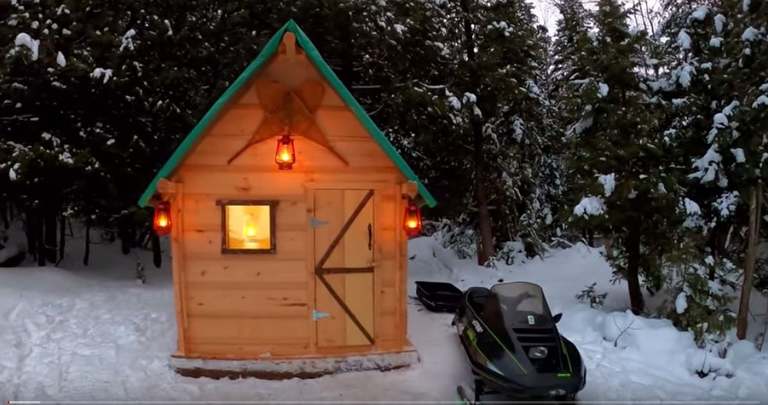
Originally published in Workbench magazine as the “Utility Cabin”, it became popular in many variations including a guest cabin, storage, studio and workshop shape. Designed specially for utilizing rough terrain, the four rebar-reinforced legs elevate the cabin above grade, and deep snow, providing a simple and adaptable foundation system. The hip roof for the small 16 x 16 cabin, with a large skylight in the center, provided an interesting and open interior, which was paneled and trimmed with cedar.

utilitycabin

Sauna Cabin

The original Sauna Cabin was equipped with a large traditional Finnish sauna in one corner. It also contained a full bathroom with tub and shower and a solo cedar therapy tub. A greenhouse window facing east provided indoor plant space and welcomed in the morning sun. The large centrally located skylight overhead provided interior light over the 256 square feet of floorspace. A sound system completed the package, making for pleasant early morning workouts.

file0048

Sauna Cabin

One of Butler’s customers, Arlen Hoskins, had this to say about his Sauna Cabin:

“This is way too good to waste on just a sauna cabin…I’m living in it! It makes a cool bachelor pad on my 5 acres. I put my little wood stove right in the middle and stuck the stove pipe out where you had the big skylite (sic), and there’s room to keep my canoe and kayaks underneath. Mostly boulders and rocks on my Oregon property anyway so the pier and beam design went up fast and cost a fraction of a traditional perimeter foundation, and I like how it’s designed to use full sheets of plywood. I sided my cabin with rough sawn cedar planks lapped one over the other and it looks like it grew right out of the hillside.”

file0102

Grand Cabin

Grand Cabin
The Grand Cabin cabin is about 140 square feet and can be moved around your property on skid beams with a tractor or truck. The small portable shelter makes a unique hunting camp or a cozy weekend vacation cabin. The basic cabin has also been adapted for refugee housing, back yard studios, storage shed and guest houses. Multiple modules of the cabin have been joined together for basic accommodation for fly-in hunting in the Alaskan bush.

For about $1000, a first class version can be built, and about half that amount for an economy version. It can be built to take-apart if necessary, constructed in a back yard and re-assembled on site in the woods. The 8′ by 12′ floorplan plus sleeping/storage loft overhead provide about 140 square feet of usable space. Hollow plywood skid-beams provide structural support and also elevate the cabin above snow, or can be propped level about rough ground. Roof overhangs provide cover for stacked wood, boats, etc.

Interior layout, door and window placement are optional. Optional insulation and a small wood stove provide winter comfort, or if an extension cord will reach the smallest 110 volt heaters will keep the cabin toasty.

Building plans include a step-by-step building manual and blueprints, all written for amateur builders. The plans for the Sauna Cabin and the Grand Cabin cost $45.

Butler Projects also sells two larger home plans that start at about 800 square feet for a two story main module which contains all the wiring and plumbing necessary for civilized living. The DIY plywood beams and floor joists were among the most popular features of those cabins.

Plywood Cabin
The Plywood Cabin is designed as a modular owner-built home with a core module around which could be added any number of options including bedrooms, garage, sunrooms, workshops, etc.

Affordable House
The core module of the Affordable House is 20 by 24 feet providing a total 960 square feet in the two floors. It has an optional sunroom and bedrooms, garages and other spaces can be added to the core as needed. Paul built this house for his family and they lived in it for two years.

The larger home plans cost around $90-$95.

I was impressed with the thought and design that went into each house to keep the size and expense minimal. Paul even has a free plan on his website for a boat table for tiny interiors!

Paul is in the process of updating his website with new photos and information. Check back on his site and the Tiny House Blog for updates on Butler Projects.

By Christina Nellemann

If you enjoyed this post, subscribe to our feed