Michael Janzen’s Projects
Michael Janzen, my friend and fellow tiny house blogger has been real busy lately and I wanted to update you on a couple of his projects.
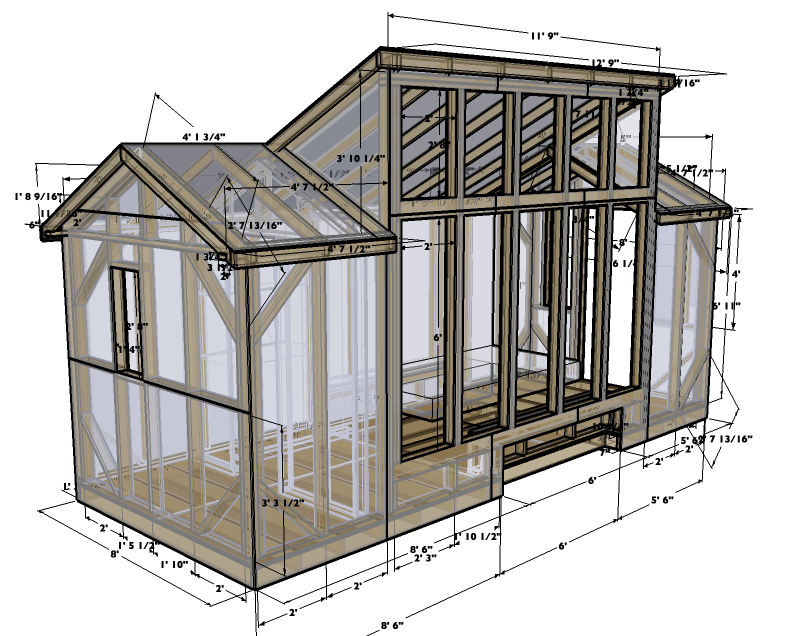
First, Michael just put the finishing touches on the 8×20 solar house and uploaded the plans. Michael has posted the first version of the plans for the 8×20 online for your review. He would like your input on his plans so go here to check it out.

Second, Michael took the day off from work and took a half-day trip up the the farm the other day. He spent a few hours working on the Tiny Free House, shooting some photos and video. Michael hopes this is the beginning of a series of trips that will get him a lot closer to completing the Tiny Free House. Below is one of the videos and you can go here to see a few more of the videos he shot.
Third, Michael has designed a Murphy Bed to go inside of his 8×20 solar house. It’s a queen size bed mounted horizontally. This allows some space to walk around side of the bed past the main windows but more importantly allows the whole thing to fit under the ceiling. The bed is a bit higher than normal so that it clears the wheel well. See his Murphy bed post here.
Keep up the good work Michael, I personally enjoy seeing your designs and check your blog regularly to see what new idea you have come up with.

If you enjoyed this post, subscribe to our feed
Mule Drawn Tiny Home
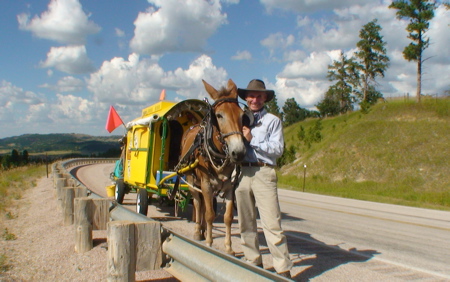
13 months in a 21 square foot, Mule drawn Tiny Home
Bernie Harberts of River Earth recently bought a set of Sonoma Shanty plans and when we were communicating by email because he is wanting the shanty on wheels version, I discovered his website and learned about his interesting story.
Bernie recently downsized his wagon for a second journey across America, he went from 60 square feet down to 21 square feet in order to cut down weight and make his home more easily pulled by his trusty mule Polly.

Everything I ever built in my life has/had wheels under it: from the boat I sailed alone around the world to the boat I built and sailed from Canada to the Bahamas to the wagon I lived in while voyaging from Canada to Mexico.
Bernie’s old wagon was 2360 pounds, empty and he designed his new one to be only 800 pounds. Here is what Bernie has to say about his design.
This time I paid closer attention to what the original pioneers wagons measured. I took a tape measure to my mule skinner buddy Tash Hudson’s wagons. The beds on his traditional wagons measured 36″ to 48″ wide, fully 2 feet narrower than my original wagon. Another friend, Sue Maska, who spent 5 years traveling the country with her husband in their horse-drawn wagon, gave me tips on a practical interior layout. Their wagon was only 3 feet wide.
Then I fired up my welder and got to work. Using 1 1/2″ X 1/8″ angle iron, I welded up a steel frame that weighed 100 pounds.
To that, I attached lightweight walls fashioned from 3/4″ foam insulation sandwiched between two sheets of 1/8″ plywood.
The new wagon measures just over 2’ 6” wide by 8’ long. A 3’ covered area where I sit while driving, what I call the front porch, brings the overall length to 11’. Headroom inside, instead of 6’, was reduced to 4’ 10”.
Bernie is an author and sold books along the way to help pay for his trip. You can see two of his books pictured below. I want to encourage you to go explore his site and learn more of his story as I can’t do it justice in a short post. Visit his the General Store if you would enjoy getting one of his books and getting the full details of his travels.


If you enjoyed this post, subscribe to our feed
Tiny House Living #17
Tiny House Living is a weekly newsletter that covers the world of tiny houses and the people that choose to live this simpler life. Each entry is a short summary that links to the original article. Subscribe by Email to Tiny House Living and stay up-to-date on the news and events in our community.
In this issue: The Paper House; Small Living Journal – Why a Tiny Home?; Bush Babes; Ziggy’s Cob House; Jalopy Cabins; 8 x 20 Solar House; ReBurbia; and the Clear Village Contest. Click here to read Tiny House Living.
If you enjoyed this post, subscribe to our feed
Office Pod
I really like the modern design of this office pod, at a size of 2.1 meters square or about 6 feet 9 inches square by American measurements, you might at first think this is way to small for a tiny house.
Here is what I envision, four of these pods on a deck with a dogtrot covering between each pod. One pod is the kitchen, one the bath, one a bedroom, and one an office.
Total living space 196 square feet and if you need to add another room just add another pod. These office pods are designed in London in the UK and I haven’t found out yet if they can be shipped here or at what price. I hope to be getting some of that information soon.
Use your imagination and start thinking what you could do with something like this. At this size you could start out with one pod and than add on as you are able or could afford it. Pay as you go. You could even put them on a trailer and transport it to a different location if necessary. If you build your own, you could design it modern or rustic. Use modern materials or reclaimed or salvaged materials, your imagination is the limit. This is definitely a winning tiny house concept in my humble opinion.
To learn more about the office pod and the concept behind its design, visit the Office Pod website.
If you enjoyed this post, subscribe to our feed
Rolling Huts
When I first saw these huts on wheels, they looked a bit like an alien vehicle from Star Wars. The more I looked at them though, the more I fell in love with these sleek little houses.
Designed as a modern alternative to camping by Tom Kundig of Olson Sundberg Kundig Allen Architects in Seattle, the Rolling Huts are available for rent in the Methow Valley of Washington state. The huts are several steps above camping, while remaining low-tech and low-impact in their design.
The huts sit lightly on the site, a flood plain meadow in an alpine river valley. The owner purchased the site, formerly a RV campground, with the aim of allowing the landscape return to its natural state. The wheels lift the structures above the meadow, providing an unobstructed view into nature and the prospect of the surrounding mountains.
The huts are grouped as a herd: while each is sited towards a view of the mountains (and away from the other structures), their proximity unites them. They evoke Thoreau’s simple cabin in the woods; the structures take second place to nature.
Each hut comes equipped with a small refrigerator, microwave, fireplace and Wi-Fi. A sleeping platform is perfect for two, and the modular furniture in the living area can be reconfigured to sleep two more. Each hut has an adjacent portable toilet, and full bathrooms and showers are housed in the centrally located barn a short distance away. There is a water faucet outside of each hut and a picnic table in front of each hut that seats 12. You can stay in one of these huts for about $80-$100 a night.
If you enjoyed this post, subscribe to our feed
Jalopy Cabins
Lyle Congdon a graphic designer who runs her business, Wild Spirit Designs in Colorado is also stepping into the tiny house and cabin business and will soon be opening Jalopy Cabins. She contacted me the other day to tell me about this jalopy cabin.
Jalopy Cabins gets its name from the old jalopy truck pictured at the bottom of this article. Lyle has one completed cabin pictured here and it is for sale. Here is how Lyle describes it:

This cabin is 140 square feet. We are asking $10K and can finish it out however someone may want.
I personally think it would make a great guest cabin or art studio/office as is. Currently wired with electricity, and does not have plumbing. We would consider selling it with some of the items in the picture (ie. wood stove, counter/storage).
We’ve moved it once before on a flat bed trailer so I feel pretty confident we could ship anywhere, will just be a matter of cost depending where the person lives. We are located in Southwestern Colorado (Pagosa Springs to be exact!) for a point of reference.
The Jalopy Cabins website is still being developed, if you are interested in getting more information you can email Lyle at info@jalopycabins.com.
If you enjoyed this post, subscribe to our feed
Tiny House in a Landscape
This weeks “Tiny House in a Landscape” is a tiny house on the banks of the Nam Khan river. Luang Prabang, Laos.
A relaxing retreat over the river, as long as it doesn’t get flooded and the bridge holds up. Gorgeous tropical paradise with a lovely view of the water.

Nam Khan River
If you enjoyed this post, subscribe to our feed
Nova Scotia Fish House
I recently discovered a cool blog called the Nova Scotia Island Journal written by Anne Yarbrough.
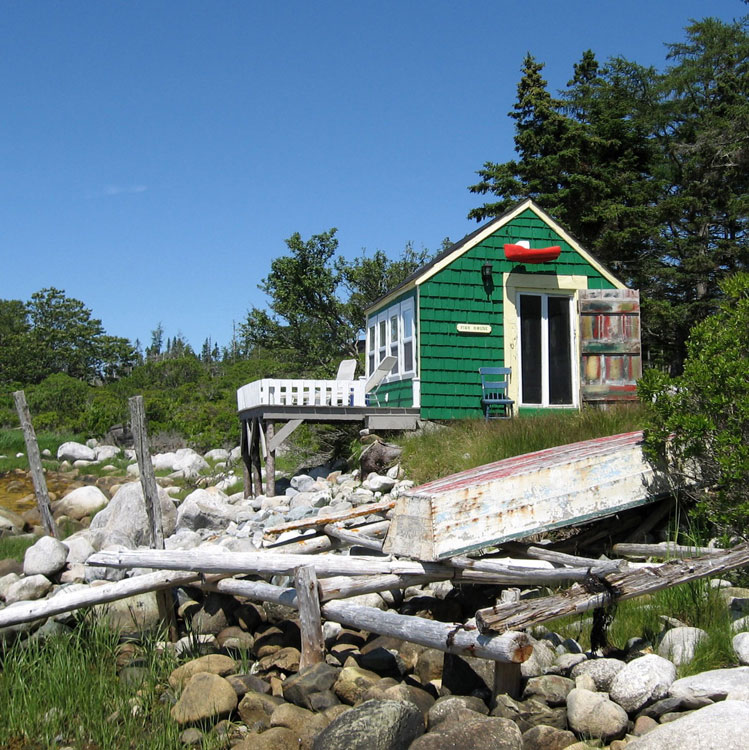
I stumbled across a recent post called the fish house. Anne and her husband live on a small island in Nova Scotia called McNutt’s Island. They live in a fisherman’s house on the island but there are also two fish houses on the island and one of them has been restored to be a guest house. I’m going to let Anne tell you more about it.

The house we live in is the last old fisherman’s house left on McNutt’s Island. But there are two old fish houses that still stand. In the old days the fishermen used these sheds to repair their nets and their other fishing gear, and for storage.
Greg restored the fish house and you can read all about it and see pictures before and after at the fish house post. Let’s move on to the interior.
It’s an easy tour since the fish house is eight feet by twelve feet. All you have to do is stand in one place and look around.
We discovered many interesting things stored here — lobster buoys, tools, doors, frames, furniture, oars, fishing poles, old lanterns, things like that. Some of these things have returned to the fish house. Now they are objects of art, or at least objects of interest.
Greg took up all the floor boards and sanded and polyurethaned them. He put down a sub-flooring of plywood before he re-installed the wood floor. He built a tiny french screen door. This door is so little that even I have to duck to get inside.
Speaking of ducking, we found these old silhouette decoys stored in the fish house when we moved here. They were originally black, of course. No ducks would be fooled by them now.
The desk was in the main house when we moved here. It may have once been the desk for the island post office.
There’s plenty of room for a queen-sized bed. Greg built a new window high on the north wall, above the bed. It opens and closes very cleverly.
To learn more go to Anne’s Nova Scotia Island Journal. I think you will become addicted to it just like I am.
If you enjoyed this post, subscribe to our feed
Ecohouse
Alex recently transplanted himself and his family from the busy life of New York City to a rural setting in Sweden. Alex has started a blog called EcoHouseFilm that he is documenting his families life changes.
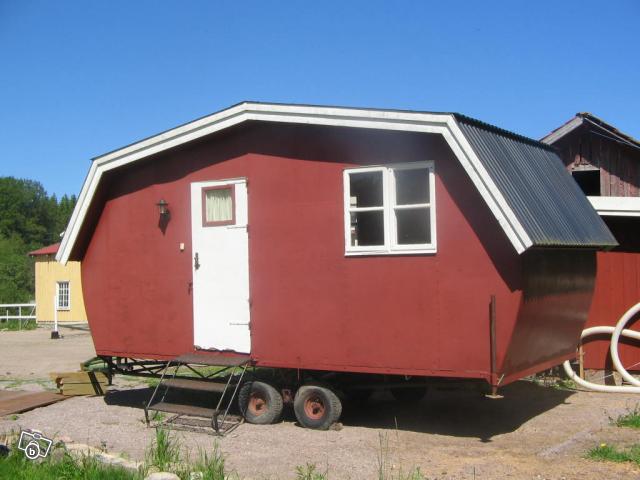
Alex, his wife and his son are currently restoring a 50 year old house they inherited with the mountain, it is 25 square meters in size.
Alex says: We are stripping it of the paint and fungus and are going to add insulation on a 2×6 external frame plus a bigger roof with a loft, as the current wood is just 2 inches thick and does nothing for the minus 20 celsius winters in Sweden.
Overall it will be 35 meters square after that, so still a tiny house for a family of three.
Some of the wood is going to be locally sited from the property, and I want to buy all the wood from Sweden, which is easy, as we do produce a lot of wood.
We have a horse ant problem, and as you can tell from the name, a horse ant is big and makes pinkie size holes in wood!
The roof needs to be changed as well. We are hoping to be ready for the winter, and I will build another small house for my workshop comes spring.
In sweden there is no regulation if your house is on wheels, pretty much like in the United States so I will be building several of those.
There is a whole little house movement in Sweden, the friggebod, as a house under 15 square meters is unregulated.
The friggebod is at the heart of all things Swedish and lagom. A small house often confused for a shed, the Friggebod is 15 square meters or less, and thanks to the humanity of Swedish law, requires no permit or inspection to build on.
Overall, our move to Sweden has been going smoothly.
The environment and schools are much better, but everything is three times more expensive than the United States.
Of course plumbing and sewage is a royal bitch, as in all “civilized” countries. We will try to push for a greywater reed bed.
Watch a movie below that shows an interesting angle of their move to Sweden. Visit the EcohouseFilm blog here.
If you enjoyed this post, subscribe to our feed
Tiny House Living #16
Tiny House Living is a weekly newsletter that covers the world of tiny houses and the people that choose to live this simpler life.
Each entry is a short summary that links to the original article. Subscribe by Email to Tiny House Living and stay up-to-date on the news and events in our community.
This week a few of the subjects are: Tumblewagon, Sonoma Shanty, Moonroom, Steven’s Summer Project, Yonderosa, and Creative Cooling.
Read the latest of Tiny House Living here.
If you enjoyed this post, subscribe to our feed